A carbon fiber brand can compete beyond the lowest price by serving a defined buyer with supported product information and a consistent service promise. That requires more than a logo on a familiar part. The customer needs a credible reason to choose your offer and a clear understanding of what it includes.
For an aftermarket brand or private-label seller, differentiation can come from application focus, selection help, documented supply scope or an operational service you actually provide. Do not claim a unique laminate, exclusive design or superior performance simply because the packaging carries your name.
Choose the buyer before choosing the slogan
Define a useful audience: a vehicle specialist serving repeat workshop customers, an online seller helping owners select a specific application, or a local distributor supporting installers. “Premium carbon fiber for everyone” does not tell your team which customer problem deserves attention.
Look at inquiries, declined quotes and support records. Are customers struggling to identify versions, compare finishes, understand contents or arrange the next stage of their build? Choose a problem your business can solve repeatedly, not just in one carefully managed sale.
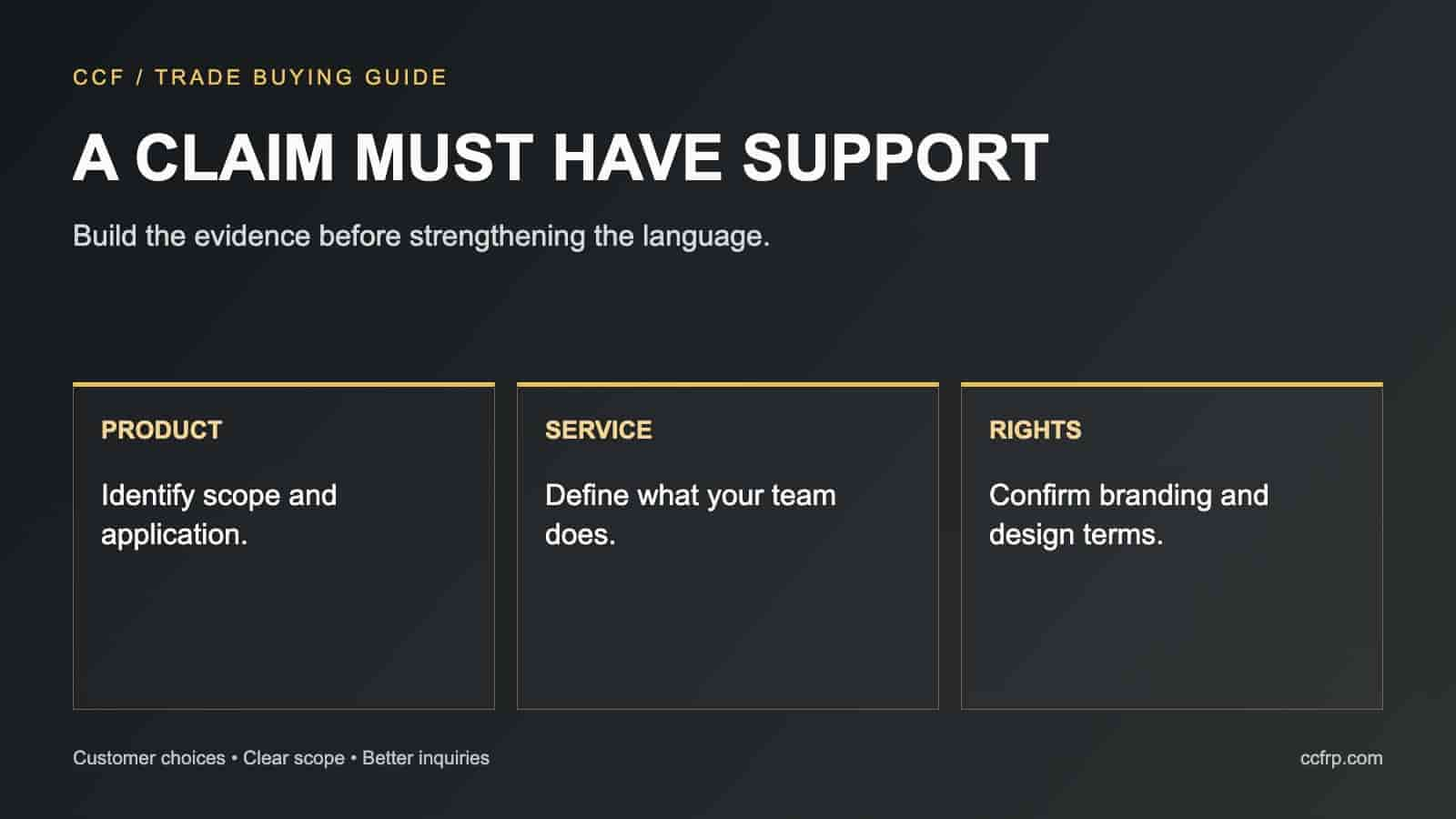
Build a claim-and-evidence matrix
| Proposed positioning | Evidence or process needed | Wording to avoid without proof |
|---|---|---|
| Focused vehicle knowledge | Accurate reference data and a defined clarification process | “Fits every version perfectly” |
| Clear supplied scope | Current contents and sales-unit records | “Complete kit” when pieces remain unspecified |
| Local support | A real contact and a support process your team can deliver | “Instant resolution” |
| Distinctive design | Supported design provenance and rights | “Exclusive” without an agreement |
| Documented construction | Product-specific supplier evidence | Weight or strength superiority inferred from appearance |
Remove a claim if the required evidence is missing, or narrow it to what you can substantiate. The construction comparison guide helps keep material labels accurate. Differentiate through clarity rather than replacing one vague marketing phrase with another.
Write an offer that survives a comparison
For a hypothetical vehicle-focused brand, a useful statement might be: “We help owners identify the relevant exterior reference before ordering, with supplied contents recorded in the quote.” That promise is only appropriate if your team performs the check and documents the result. It does not imply guaranteed fitment or manufacturer approval.
Compare your offer with alternatives on a small set of relevant dimensions: application help, documented contents, delivery scope and actual support. Do not invent shortcomings in competitors or imply that a higher price proves better quality. Let customers see the specific difference they are paying for.
Make the product range reinforce the position
If your brand is focused on a vehicle platform, build an understandable reference hierarchy and keep each part’s application independent. A coordinated visual range should not conceal unverified compatibility. The BMW range-planning guide illustrates how to start from customer demand.
If you plan private labeling, agree on product identification, artwork and packaging before publishing the offer. Use the packaging approval checklist. A branding request does not automatically mean the underlying product becomes exclusive to your company.
Give the sales team evidence it can use
Create one short record for each major promise: the wording, what supports it, who maintains it and when it must be reviewed. If a supplier changes a reference or your fulfillment arrangement changes, update the promise. Sales copy that was true for one shipment may not describe every future order.
Ask permission before using supplier images, customer photographs or third-party marks. A genuine customer photograph can support a description of an actual project, but it does not prove a general performance claim or authorize you to publish private purchasing details.
Test whether the positioning affects buying decisions
Record why customers choose or decline your offer. Review completed orders, repeat demand and support costs, not just engagement with a slogan. An increase in average selling price is not enough if the new service promise adds more cost than it earns.
For a brand considering a genuinely new product, use the tooling business-case guide. For an existing catalog range, a better-defined service proposition may be a more practical first step. Discuss private-label or OEM scope with CCF using the customer value you intend to deliver, not just a request to add a logo.
Frequently Asked Questions
Does private labeling make a product exclusive?
No. Branding, design rights and exclusivity are separate commercial questions requiring confirmation.
Do I need a custom mold to differentiate?
Not necessarily. A focused range and a consistently delivered service can offer value. Custom development needs its own demand and cost justification.
Discuss a Brand-Focused Product Range
Tell CCF whom your brand serves, which vehicles matter and what supported difference you want to offer. Start a private-label or development discussion with a customer objective, not just an artwork file.
Tell Us About Your Business
Include your market, customer vehicles, selected parts and trial quantities.