A carbon fiber distributor can build a local reseller network by helping a focused group of shops quote and support relevant products consistently. The value is not simply sending a catalog to more addresses. It is giving each shop a clear route from a customer vehicle to a defined part, a usable trade offer and reliable communication.
This guide is for a distributor recruiting its own downstream shops. It is separate from applying to become a CCF channel partner. Your authority to use branding, appoint resellers or claim a protected territory must come from the actual cooperation agreement, not from purchasing wholesale goods.
Define what your local network provides
Choose services you can deliver: local-language product clarification, consolidated purchasing, selected local stock, installer coordination or order follow-up. If you do not hold inventory, do not advertise a local-stock advantage. If supplier assistance is required for technical questions, explain that process rather than promising instant answers.
Prepare a one-page offer describing your vehicle focus, supplied range, ordering method and support contact. Shops should understand why working through you is useful beyond a temporary price difference.
Qualify shops by their actual customer base
| Question | Useful evidence | Why it matters |
|---|---|---|
| Which vehicles does the shop serve? | Its normal service mix and customer requests | Matches the first product shortlist |
| Can it sell and support exterior parts? | A named sales and workshop contact | Prevents unsupported customer promises |
| How does it quote? | Its product-identification and approval process | Helps avoid ambiguous orders |
| What does it need from you? | Stock, information, shipping or another defined service | Shows whether your offer solves a real problem |
A large social audience alone is not proof of relevant demand. Ask for an anonymized description of common jobs rather than unnecessary customer personal data. A small specialist with repeated requests for one platform can be a better first partner than a broad retailer that cannot identify the product.
Give the first shop an operational starter pack
Include a limited reference list, permitted images, confirmed sales units, the quotation process and a route for fitment questions. Use the dealer product-data guide and confirm image permissions before redistributing assets.
For BMW-focused partners, begin with vehicle-based range planning. Do not hand every shop the entire catalog and assume it knows which references to promote. Keep prices and availability in a controlled record so an old screenshot does not become a standing offer.
Make a first order easier to execute
Assign one contact to check the shop’s first quotation request. Confirm the selected vehicle application, reference, finish, quantity and delivery scope. Record questions that could be answered once in the starter pack. When the order arrives, ask whether the supplied contents and documentation matched what the shop expected.
This onboarding effort has a cost. Track it separately from recurring order handling. A partner that needs more support initially may still become valuable, but the decision should be based on actual repeat behavior rather than the number of accounts opened.
Measure active partners instead of contact lists
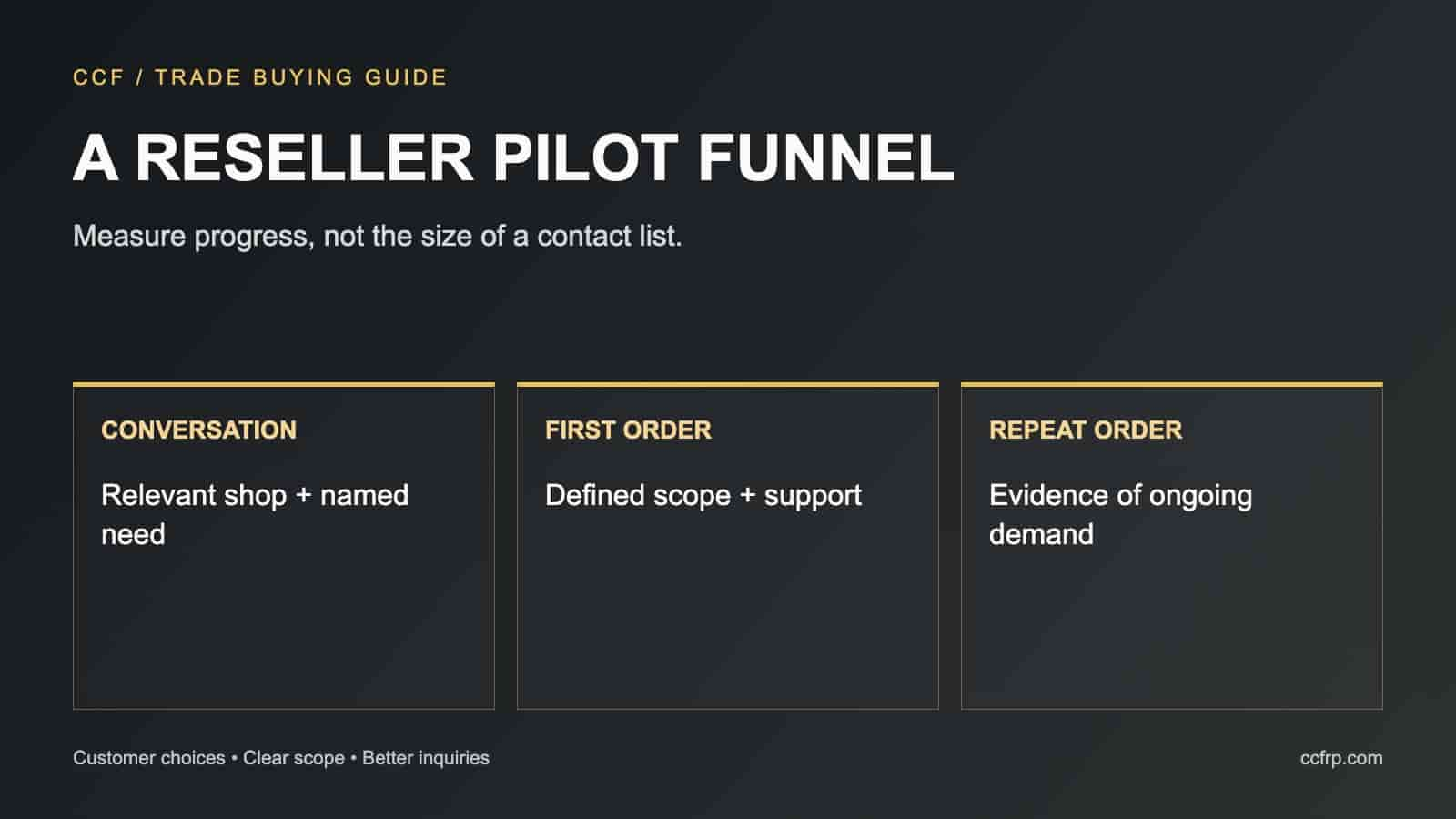
Use a simple funnel: shops approached, relevant conversations, complete quotations, first orders and repeat orders. Define each stage. A shop receiving your price list is not yet an active reseller. A first order bought for a single customer does not establish predictable monthly demand.
In an illustrative pilot, 12 relevant conversations might lead to six complete quotes, three first orders and two later repeat orders. Those invented numbers are a tracking example, not a forecast or acceptable benchmark. Investigate where your actual funnel loses momentum and improve that stage before recruiting more shops.
Protect the relationship with clear commercial scope
Define payment, shipment handling, product-information updates and claim communication. Confirm any branding permissions in writing. Avoid implying exclusivity, lead referrals or a right to represent the manufacturer without agreement. The channel-cooperation checklist helps structure those discussions.
Keep your own prices tied to costs and services; use the trade-pricing worksheet. Build a network that can repeat a clear transaction. A bigger mailing list is not a substitute for shops that understand the products and come back with the next order.
Frequently Asked Questions
Does wholesale purchasing make me an exclusive distributor?
No. Territory, branding rights and any exclusivity need a separate confirmed agreement.
Should I offer local stock for every product?
Only when the demand and economics support it. A quotation-led range can sit alongside a smaller verified stock list.
Discuss Your Regional Wholesale Plan
Bring CCF your target market, shop network, vehicle focus and first product shortlist. Start a channel discussion grounded in how you intend to serve those customers.
Tell Us About Your Business
Include your market, customer vehicles, selected parts and trial quantities.