CARBON PARTS WORKSHOP SERIES · 10
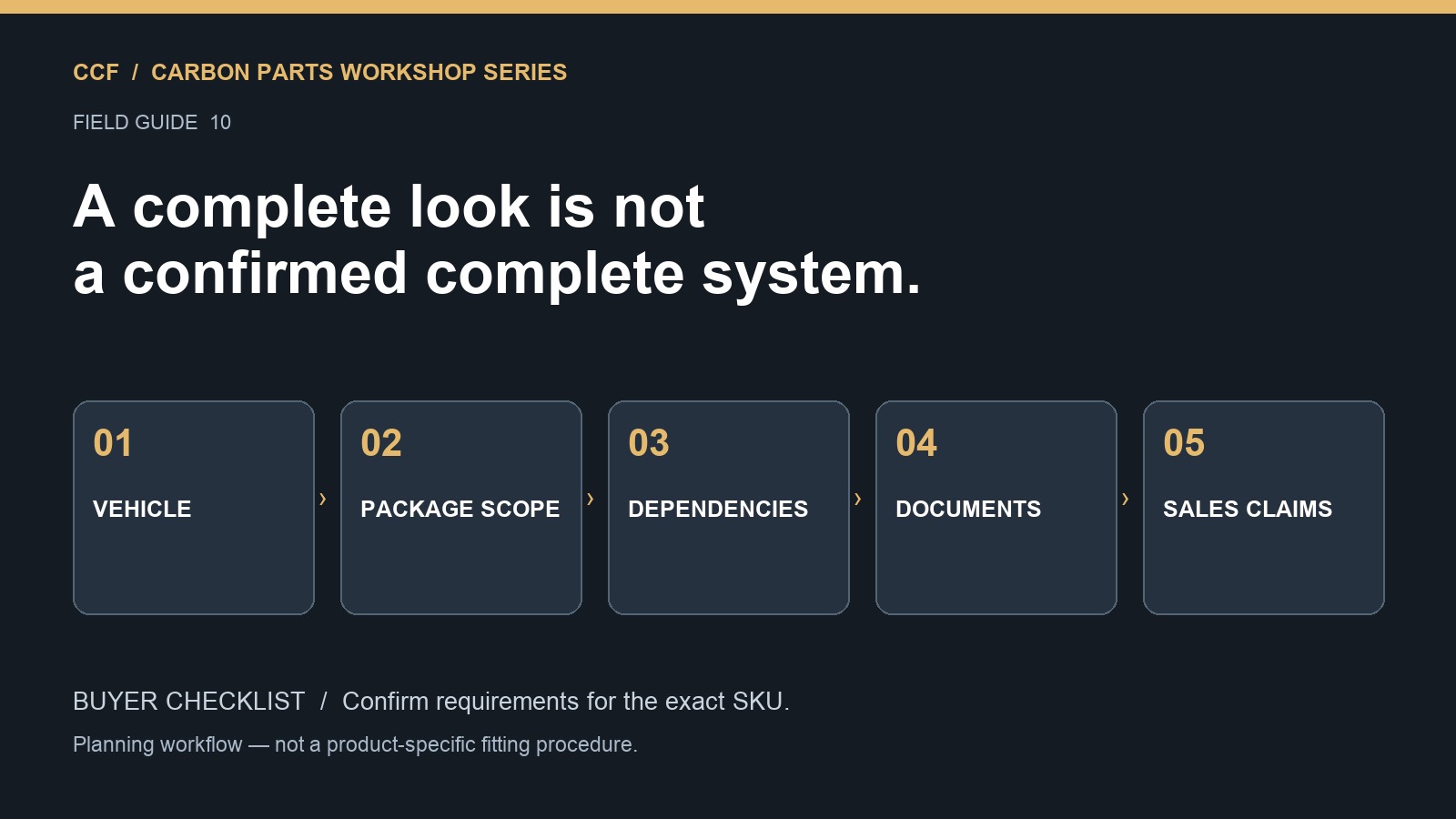
Before ordering a Porsche 992 aero package, identify the exact vehicle, the components in the offer and any dependencies between them. A collection of matching carbon parts is not automatically a tested aerodynamic system. A buyer needs to know which statements concern appearance, which concern physical application and which have supporting performance evidence.
This Carbon Parts Workshop Series article helps tuning shops and distributors define that distinction before quoting a build. It does not provide installation instructions or establish the performance of a CCF package.
Start with the specific 992 application
Record the model year, body and variant, relevant equipment and existing modifications. Keep Carrera, Turbo S, GT3 and GT3 RS references distinct. Do not assume that a guide covering one variant extends to another because both are described as a 992.
For front-end enquiries, the 992.1 versus 992.2 front lip guide helps frame application questions. Its purpose is selection; the package review must still establish the components and requirements of the exact order.
A precise example from the GT3 RS Manthey document
Porsche’s 992 GT3 RS Manthey kit document, dated January 30, 2025, identifies a GT3 RS application from model year 2023. It states that components were tested and approved in combination and lists kit variants associated with equipment differences. It also distinguishes aerodynamic and chassis scopes; it does not say the aerodynamic package always requires the chassis package.
This is a narrow manufacturer example of configuration-dependent ordering. It does not validate an aftermarket collection of visually similar parts or make its requirements universal to all 992s. The practical lesson is to ask what belongs together, what is separately optional and which configuration a claim actually covers.
Separate three meanings of “package”
| Package description | What the buyer should establish |
|---|---|
| Styling bundle | The individually specified components being sold together and their confirmed applications |
| Installation combination | Interfaces, supporting components and documentation needed for the proposed combination |
| Validated performance package | The evidence, configuration and conditions supporting each performance statement |
These descriptions should not be treated as interchangeable. A supplier may offer a styling bundle without claiming system-level aerodynamic validation. That can be a clear, honest offer when its scope is stated accurately.
Build a dependency list before asking for a final price
Give each component its own order line. Record its SKU, vehicle application, supplied contents and anything required from another order line. If a rear wing is proposed, identify the assembly rather than only the visible wing element. Our 992 rear wing assembly checklist helps define that scope.
For each dependency, ask whether it is confirmed, excluded or unresolved. Examples of questions include whether a particular mounting base is required, whether an existing body component must be compatible, and whether the chosen configuration has product-specific instructions. These are questions to resolve, not claims that every kit has the same requirements.
Do not substitute compatibility with an individual fitment label
Two components may each be offered for a vehicle without the combination having been assessed. If the customer mixes suppliers, identify who can review the interfaces and what evidence is available. Do not quietly assign responsibility to the installer after the order has shipped.
For a Turbo S enquiry, keep the Turbo S application checks separate from the GT3 RS example above. The source model is part of the fact being cited; removing it changes the meaning of the claim.
Compare offers without inventing equivalent performance
Imagine a customer requests a rear wing, front lip and rear diffuser because they like a track-inspired appearance. Quote those identified items and the reviewed work scope. Unless relevant evidence is available, do not describe the selection as reproducing another manufacturer’s downforce, balance or track performance.
This is a hypothetical sales scenario. The distinction protects the clarity of the offer: the customer can buy a stated styling configuration without being sold an unsupported technical result. If performance is central to the purchase, ask for the relevant data and its application conditions before making that promise.
Separate delivery readiness from workshop readiness
A package can be ready to ship while the installer still needs information. Before confirming a firm appointment, have the workshop review the actual component list, instructions and open questions. Identify separately required items and any configuration checks still outstanding.
The installation quotation framework helps distinguish product cost, reviewed labor scope and conditional work. Do not borrow the time allowance from the Manthey document for a different product or vehicle.
Retain the final configuration record
When the order is approved, preserve the component list and the supplier’s answers together. If a component changes before dispatch, revisit the affected dependencies rather than simply accepting a new photograph. The final invoice alone may not explain why a particular combination was selected.
For dealers, this record also supports later enquiries about replacement pieces. A part sold as a replacement should be checked against the original configuration and revision, not merely against a broad package name.
Buyer questions
Does buying all components from one supplier prove they were tested together?
No. Ask what combination was assessed and which claims the available evidence supports.
Can a GT3 RS guide support a Turbo S installation?
Not as a substitute for the correct vehicle and product instructions. Keep the application boundary explicit.
Should every kit include suspension components?
No universal rule applies. Establish the scope and dependencies of the identified package instead of importing requirements from another system.
Request a configuration-specific trade quote
Send CCF the exact 992 variant, vehicle photographs, desired component references, quantity and destination. State whether the priority is styling or a performance requirement. Ask which products, combinations and supporting information can be confirmed before the customer approves the build.
Editorial reference check: 18 October 2026. Referenced manufacturer documents apply to their identified products. Confirm CCF SKU requirements separately.