
CARBON PARTS WORKSHOP SERIES · 01
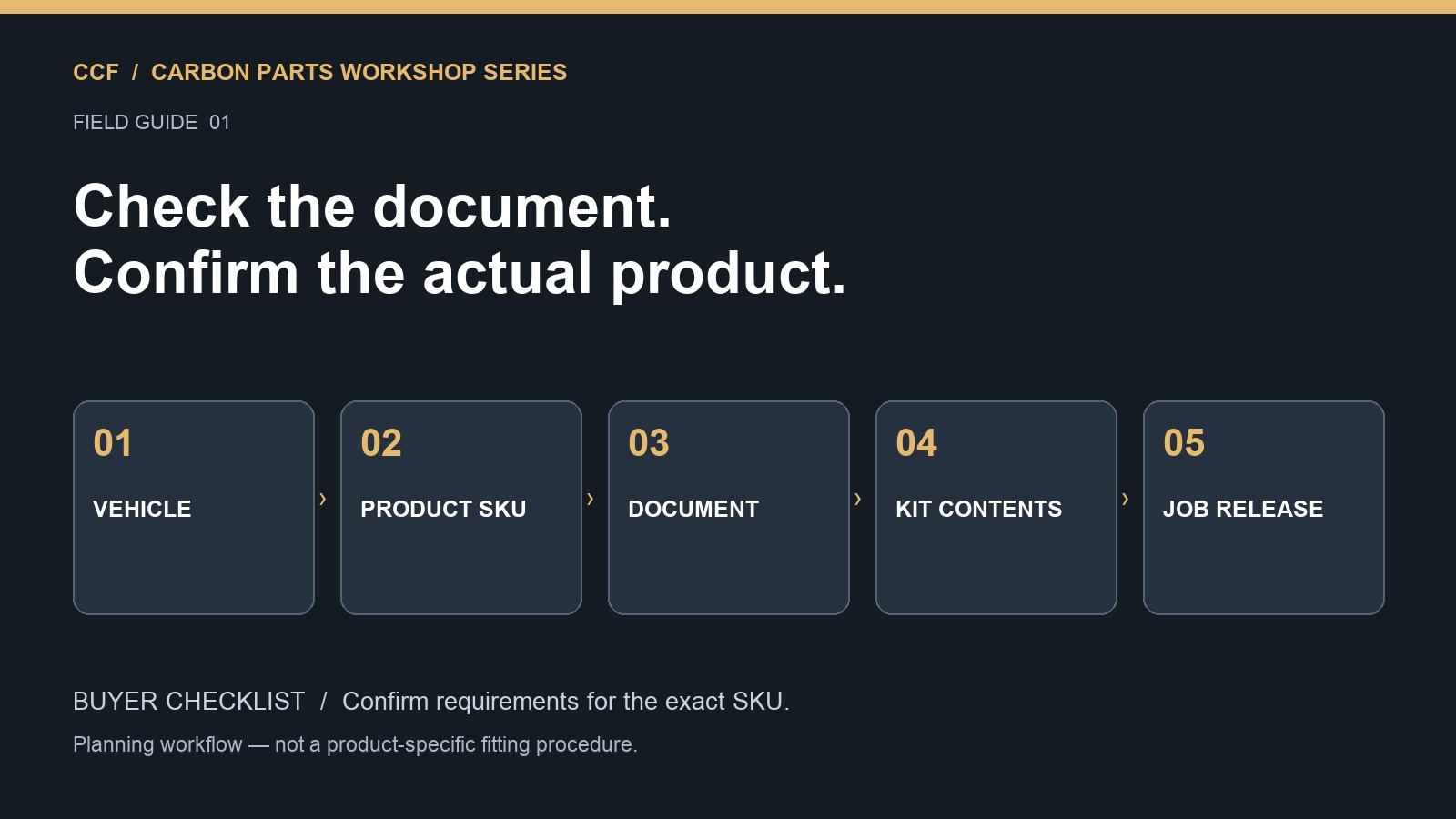
Before accepting a carbon parts installation job, make sure the vehicle, quoted SKU, supplied package and installation document refer to the same application. A manual with a familiar car on the cover can still describe a different product. The most useful document review ends with a clear decision: ready to order, ready to schedule, or waiting for a specific answer.
This first article in the Carbon Parts Workshop Series gives tuning shops, distributors and private-label buyers a repeatable review process. It concerns procurement and workshop handover. It does not replace the instructions supplied for the actual part.
Start with the job, not the PDF
Create one record for the customer’s vehicle and intended purchase. Include the model year, market, body version, relevant photographs and known modifications. Then record the supplier’s SKU and revision, the quantity and whether the price covers one component or a complete set. Keep the manufacturer’s part number separate from your internal stock code.
For a distributor, this record belongs to the stocked application as well as the first sample. If your listing serves several body versions, do not assume one successful installation establishes all of them. Record which applications have evidence and which still require confirmation. Our remote sample review guide helps organize the photographs needed when the buyer and supplier are in different countries.
Review five connections before approving the order
| Connection | Evidence to request | What should stop approval |
|---|---|---|
| Vehicle to product | Written application linked to the SKU and relevant vehicle details | A broad model label that leaves the actual body or bumper version unresolved |
| Product to document | Document title, identifier, revision and supplier confirmation of applicability | A document for another brand’s similar-looking part |
| Document to package | Itemized supplied contents and photographs | Required brackets, pads or instructions absent from the confirmed scope |
| Package to workshop | Installer review of required tools, materials and preparation | The installer cannot establish the intended attachment method |
| Workshop to customer | Agreed work scope, unresolved conditions and handover requirements | A fixed promise based on assumptions nobody has confirmed |
A blank field is not automatically a failed product. It identifies the answer that must be obtained before the next commitment. This is more useful than marking every enquiry “approved” after receiving a generic installation video.
Identify what kind of document you actually have
A vehicle workshop manual describes procedures for the vehicle. An accessory guide describes a particular accessory. A supplier’s product sheet may state the intended application without explaining installation. A promotional video may show the result while omitting access, materials and inspection. Keep these functions separate in the job file.
For example, Toyota/TRD’s Supra parts table links instructions to identified accessories and application conditions. It is a useful source for those products, not a compatibility statement for an aftermarket copy. Likewise, the Turner G42/G87 wing guide concerns Turner’s wing. Its existence does not confirm a CCF wing uses the same mounting arrangement.
Separate supplied items from required items
Ask two different questions: “What arrives in the carton?” and “What does the installer need to complete the job?” The answers may differ. The supplier should identify product-specific hardware, while the installer should review workshop equipment and consumables against the applicable instructions.
Do not fill a missing material specification with a familiar adhesive name. Where bonding is specified, the relevant product and substrate requirements need to be known. The adhesive selection questions are useful for that discussion, but do not provide universal approval for every carbon part.
Use a short release record
Keep the record alongside the purchase order so the person receiving the goods can see what was agreed. The following is a suggested internal control, not a manufacturer certification:
- Vehicle/application record and customer reference.
- Quoted SKU, revision and sales unit.
- Instruction identifier or supplier-provided file, with the date received.
- Included and separately required items.
- Unresolved questions, the person responsible and the answer received.
- Installer’s decision on scheduling after reviewing the actual scope.
If a supplier changes the product revision after the order, ask whether the previous instructions still apply. A replacement attachment method should trigger another review, even when the visible carbon finish appears unchanged.
An example of a useful hold
Imagine a shop receives a quote for a multi-piece front lip, but the only instructions supplied show a one-piece lip from another manufacturer. The correct response is not to guess that the fixing points are shared. Ask for the quoted part’s mounting details and supplied contents, then have the installer review them before confirming labor.
This example is illustrative, not a reported CCF installation. It shows why the hold should name the missing information. “Awaiting SKU-specific attachment information” gives the supplier a solvable request. “Not enough information” does not.
Turn the review into a clearer customer quote
Once the scope is known, separate the product price from installation and any conditional work. Do not borrow another manufacturer’s installation time as your own guarantee. Use the installation quotation framework to make assumptions visible, and retain the document reference in the customer handover record.
Buyer questions
Is an original manufacturer PDF always the right instruction?
Only for the application and product it covers. It can provide background for an aftermarket purchase, but the aftermarket supplier still needs to identify the requirements of its own SKU.
Should a distributor keep instructions for each revision?
Keep the document associated with each supplied revision and ask how changes are communicated. That makes it easier to support a dealer who bought an earlier batch.
What if no specific instructions are available?
Ask what information is available and have the installer assess the gap before committing. Do not advertise a documented installation process that has not been supplied or verified.
Request a document review with your quotation
Send CCF the vehicle details, product reference, quantity and destination. Include your installer’s documentation questions so the quotation discussion can identify the available information and any outstanding checks before ordering.
Editorial reference check: 18 October 2026. Referenced manufacturer documents apply to their identified products. Confirm CCF SKU requirements separately.