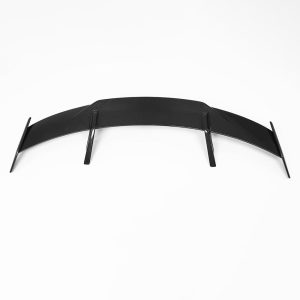
Choose an existing BMW carbon fiber catalog product when its documented application and specification meet the brief. Request a development review when the required change affects the part itself. Branding, packaging and a new component design are not the same project, and they should not start with the same assumptions about cost, timing or approval.
For a tuning shop, the immediate goal may be one customer build. For a distributor or private-label brand, it may be a repeatable product line. Define that goal before asking a manufacturer for “OEM pricing.” A clear purchasing route lets the supplier respond to the actual work required.
Start by describing what must change
Use a reference photo to explain the desired result, but add a written description. Does the buyer want the listed part as supplied, different packaging, a specified finish, different mounting geometry or a completely new design? A photo alone rarely separates those requirements.
Identify the vehicle and the intended function. Include chassis, body version, model year, market and known modifications relevant to the component. For an existing product, include its exact link or supplier reference. The BMW catalog entry points can help establish whether a candidate already exists.
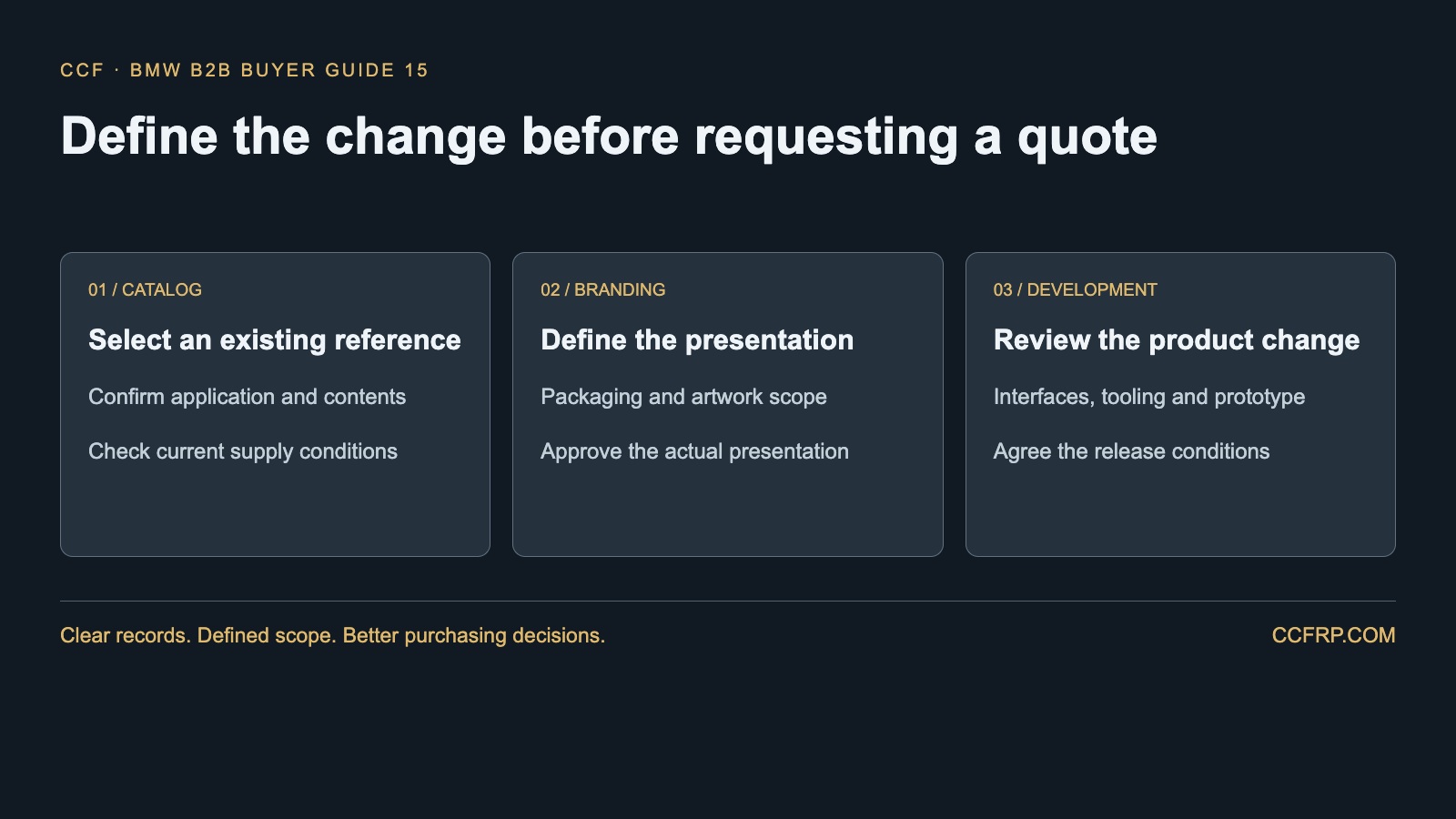
Compare four possible routes
| Route | Typical buyer requirement | What needs confirmation |
|---|---|---|
| Existing catalog purchase | A listed reference meets the job | Application, specification, contents, availability and order conditions |
| Branding or packaging discussion | The part is unchanged but presentation differs | Brand assets, packaging scope, feasibility, quantities and approval sample |
| Product variation review | A requested finish, material or other specification differs | Whether the change is feasible with the current process and what revalidation is needed |
| New product development | The required shape, interfaces or design are not covered | Design inputs, tooling approach, prototype, fitment review and production release |
These are discussion routes, not a promise that every catalog reference supports every option. A requested finish change may need technical review; a small visible shape change may affect manufacturing or mounting. Let the manufacturer assess the actual requirement rather than classifying it only by appearance.
When an existing reference is the better starting point
If a customer’s requirement can be met by an existing, adequately documented product, start with a product-specific quotation. Ask what is supplied, what the installer needs and which application restrictions apply. This avoids adding development work that the customer did not request.
For example, a buyer considering the G80/G82 three-piece CSL-style front lip should first identify whether that exact reference answers the brief. The listing is a candidate for review, not proof that any related chassis or bumper configuration is covered.
Existing does not necessarily mean in stock or available immediately. Request the supply status and lead time for the required quantity. Keep a catalog-order quotation separate from an assumed production reservation.
Do not turn a branding request into an undefined tooling project
A distributor may want its brand on packaging while retaining an existing product specification. Start by defining where the branding appears, which assets will be supplied and how the finished presentation will be approved. Do not assume a logo request includes changes to the part or exclusive tooling.
Use the private-label packaging approval guide to separate artwork, labels, cartons and the physical component. The quotation should state which of these are included.
If the buyer wants a logo integrated into the part, a revised surface or another product-level change, describe it separately. The supplier needs to assess the method and any effect on the specification before confirming the route.
Prepare a development brief that can be evaluated
For a new BMW component, a useful first submission contains more than a market opportunity. Give the manufacturer the inputs needed to identify unresolved work:
- Target vehicle configuration and the intended part location.
- Desired outcome, including whether the priority is appearance, packaging, attachment or a documented functional requirement.
- Reference dimensions, drawings, scan data or a physical reference that you can legitimately provide.
- Known interfaces with the vehicle and adjacent parts.
- Requested construction and finish, with any requirements that must be evaluated.
- Expected order pattern and target launch timing, clearly distinguished from a confirmed commitment.
- Who can provide access to a suitable vehicle and who approves the prototype.
The custom-project feasibility brief gives a broader framework. If scan data is involved, follow the 3D scan preparation guide so file delivery is useful for review rather than simply large.
Separate development charges from production pricing
Ask for a quotation that distinguishes the work required to reach an approved product from the cost of repeat supply. Possible lines may include design review, tooling, prototypes, revisions, validation support, packaging and production units. The supplier should identify which lines actually apply.
Do not divide an unknown tooling charge by an optimistic sales forecast and call the result a guaranteed unit saving. For internal planning, compare the total committed development cost with several realistic order quantities. Keep that model separate from the supplier’s confirmed quotation.
Discuss who owns or controls the tooling, how revisions are handled and what happens if the project stops. The tooling questions checklist helps define the discussion; a custom order does not automatically settle ownership or exclusivity.
Agree the approval stages before work begins
A practical sequence is brief review, agreed specification, prototype review, vehicle-specific assessment and production release. The actual sequence depends on the project, but each stage needs an identifiable decision and a record of what was approved.
An appearance approval should not silently become mounting approval. A prototype that looks right in a photograph may still leave fitment or functional questions open. Use the prototype approval checklist to document the scope of each decision.
Keep release conditions explicit. If the buyer changes the design after an approval, ask how that affects the prototype, tooling, quotation and schedule. Updating a drawing without updating the order record creates avoidable ambiguity.
A short example of choosing the right route
Imagine a shop has a G87 customer who wants the appearance of a listed spoiler in its standard finish. The first route is a product-specific catalog inquiry. If a reseller wants that same approved part with its own outer carton, the packaging discussion can be added separately. If the customer needs a different mounting arrangement, the request becomes a feasibility question rather than a promise of a catalog variation.
This is a decision example, not a statement that those changes are available for a particular CCF reference. It shows why the buyer should describe the change before requesting a final price.
Buyer questions
Does OEM/ODM mean a manufacturer supplies BMW?
No. It describes a manufacturing or development service. It does not establish genuine BMW status or a supply relationship with BMW.
Can an existing mold always be used for a modified part?
Do not assume so. The manufacturer needs to review the requested change, interfaces and process before confirming a tooling approach.
Should I request a sample before a custom project?
An existing sample may help assess relevant workmanship, but it is not approval of the new design. Define the project’s own prototype and acceptance process.
Send the requirement, not just “OEM price”
Send CCF the BMW application, product reference if available, the exact change required and your quantity expectations. Use wholesale purchasing for catalog supply discussions and OEM/ODM development for a project requiring feasibility review. Identifying the route early helps you obtain a quotation your team can actually evaluate.