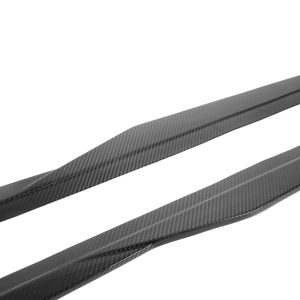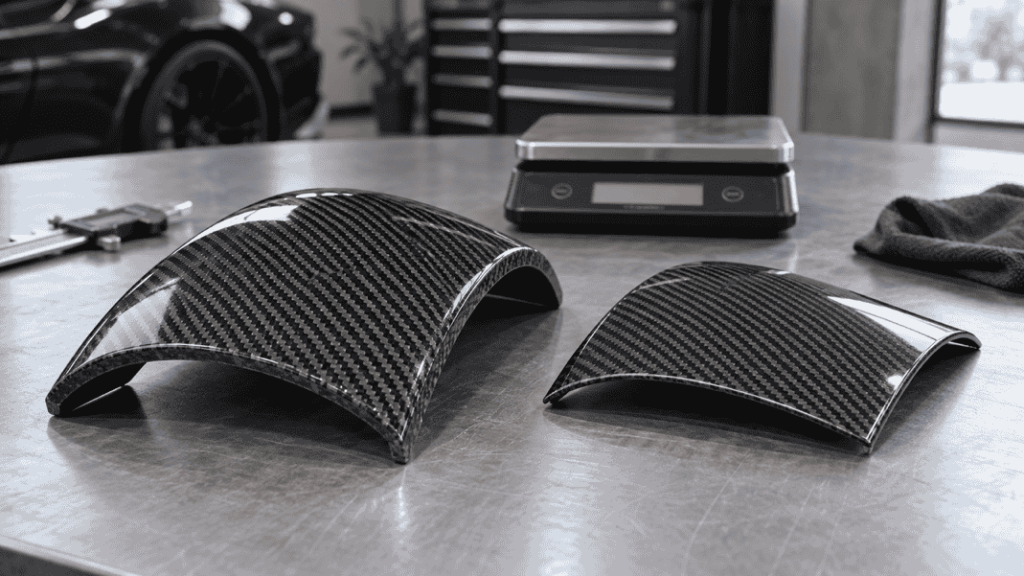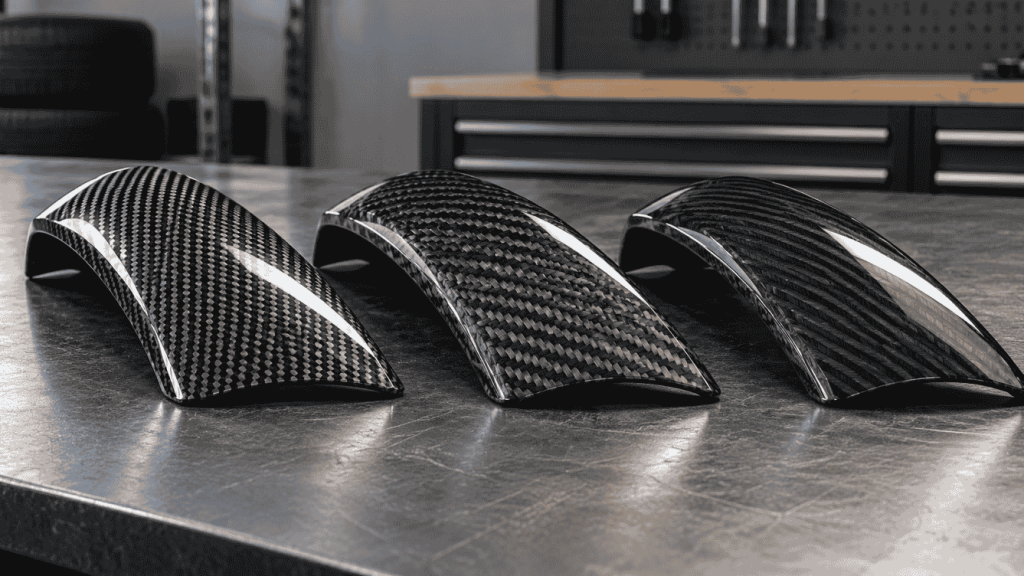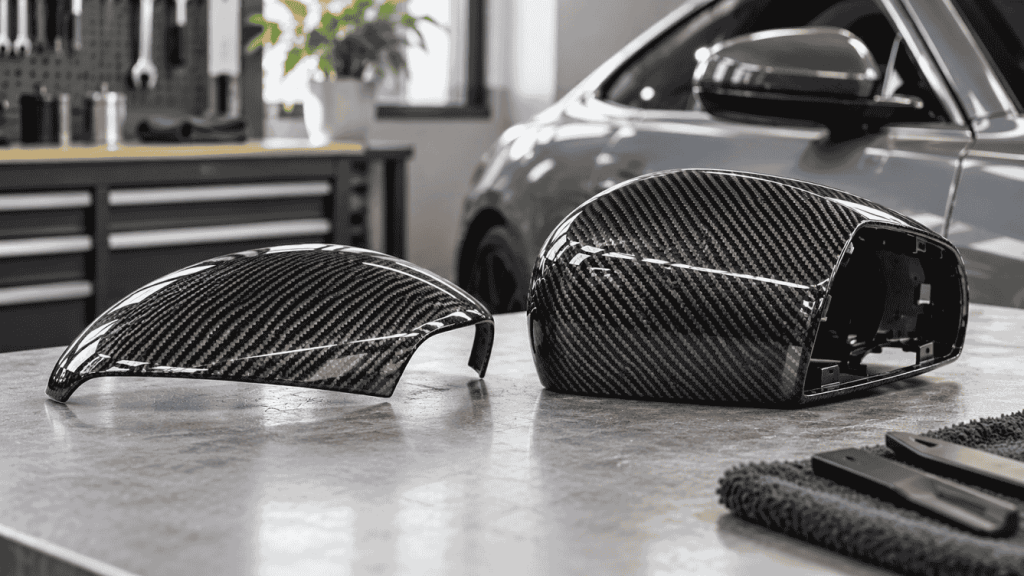
Plain weave has a one-over/one-under pattern; 2×2 twill has a two-over/two-under diagonal repeat; 3×3 twill extends that repeat to three-over/three-under. 3K describes approximately 3,000 filaments per tow, so it can describe a fabric that also has a plain or twill weave.
For automotive buyers, the useful choice is the appearance available on the actual part: pattern scale, direction around curves and gloss or matte finish. Record those fields separately from construction and manufacturing process.
How do plain, 2×2 and 3×3 twill differ on a car part?
A broad hood makes the repeat more visible than a small curved trim piece. Compare the actual fabric description and finished-part views: tow size, fabric layout, curvature and coating all affect the appearance. A 3×3 label describes the interlacing sequence; it is not a higher quality grade than 2×2.
Choose a pattern your buyer likes and your selected product can actually supply. For adjacent components, approve their visible relationship together instead of ordering by the word 3K alone.
Plain weave vs twill: what does the buyer see?
| Description | General pattern | What to specify for the order |
|---|---|---|
| Plain weave | A regular over-one/under-one layout with a grid-like appearance. | The actual visible scale, orientation and finish on the offered part. |
| 2×2 twill | An over-two/under-two repeat that produces a diagonal appearance. | The actual repeat, diagonal direction and appearance around curves. |
| Other twill or spread-tow fabrics | Different repeats or tow presentation can change the visible scale. | The exact fabric description and sample; do not identify it from a marketing nickname. |
| Chopped or marbled appearance | An irregular visual layout rather than a repeating woven grid. | Treat it as a separate construction/appearance discussion, not another plain/twill option. |
Easy Composites’ plain-weave and 2×2-twill fabric descriptions illustrate those general patterns. They are material references, not evidence that CCF uses those particular fabrics or offers every pattern for every product.
Do not use 3K as a complete appearance specification
A 3K tow contains approximately 3,000 filaments. Tow size is separate from weave layout, fiber grade, fabric areal weight and the construction of the finished component. Two fabrics described as 3K can use different weaves and produce different visible effects.
Use an actual sample to define the desired appearance rather than asking only for “premium 3K carbon.” If fiber grade, mass or performance matters, specify and verify those requirements separately. The fiber-grade verification guide addresses another field that a weave label cannot establish.
Identify the surface pattern on the actual part
Start with the product reference, vehicle application and replacement-versus-overlay design. Ask which visible weave is available on that SKU, and request current overall and close-up photographs.
A flat fabric image can show the pattern but cannot explain how it will appear on a curved mirror cap, vent opening or multi-piece lip. Review the prominent curves, edges and transitions of the proposed product. If the photograph does not establish the pattern, request clarification rather than adding a confident weave name to the listing.
Likewise, the visible surface does not establish all reinforcement behind it. Use the construction comparison guide when backing or full-laminate composition affects the purchase.
Agree pattern direction for pairs and multi-piece parts
Define the visual reference using the vehicle’s left and right sides and the part’s installed orientation. Avoid an instruction such as “the weave must lean right” without a drawing or annotated photograph; a loose component can be rotated in several ways.
For mirror-cap pairs, decide whether a mirrored presentation or another arrangement is required and actually available. For multi-piece front lips, review the center and side sections together. For long side components, show the required orientation relative to the front and rear of the vehicle.
The appropriate arrangement depends on the shape and supplied version. Do not promise identical direction across every surface. Record the supplier’s proposed layout and have the buyer approve any expected transitions.
Keep weave, finish and process as separate fields
The same broad pattern can be presented with different gloss levels. Photos can also make the scale and contrast look different. Specify the weave and gloss or matte finish independently.
A weave name does not establish whether a component was made by prepreg, wet lay-up or another route. Use the process comparison guide for that question. If the buyer wants a marbled appearance, use the forged-look versus woven guide rather than mixing that choice into a plain-versus-twill specification.
Create an appearance approval record
Agree what the sample represents and which visible areas matter. The following fields form a buyer working template, not a universal CCF production standard.
| Field | Entry to record |
|---|---|
| Identity | Product reference, application, relevant revision and component side/section. |
| Pattern | Confirmed weave description and approved visual scale. |
| Orientation | Annotated reference showing installed direction and pair/section arrangement. |
| Finish | Agreed surface appearance and comparison reference. |
| Viewing scope | Lighting and views used; areas or products not yet reviewed. |
| Accepted variation | Observed transitions or differences explicitly accepted for this order. |
| Approval record | Reference images or sample ID, approver, date and remaining questions. |
Keep the reference with the accepted order. A physical sample can support a closer comparison than separate screen images, but approval still needs a defined scope. A photograph of one finished product is not a promise that every visible strand will occupy the same position on every later part.
For a whole-vehicle BMW package, the appearance-matching guide explains how to compare existing and new pieces. That article covers the build-level decision; this page supplies the weave specification vocabulary.
Preserve the reference through listings and reorders
Use product photos and wording that describe the offered version. Do not label a pattern as a measured strength advantage or infer a cure method from the diagonal appearance. Obtain permission for supplier images before using them in resale listings.
For repeat supply, identify the approved reference and require review of proposed appearance or construction changes. A similar catalog thumbnail is a poor substitute for a maintained product record. Keep any accepted variation linked to the specific order rather than applying it automatically to a new customer.
Confirm the Weave Available on Your Selected Parts
Send product references, an appearance sample or marked image, required pair direction, finish, quantity and destination. Ask which options are existing supply and which need development review.
Send Your Product Requirements
Include your company, selected product or project reference and the question to resolve.