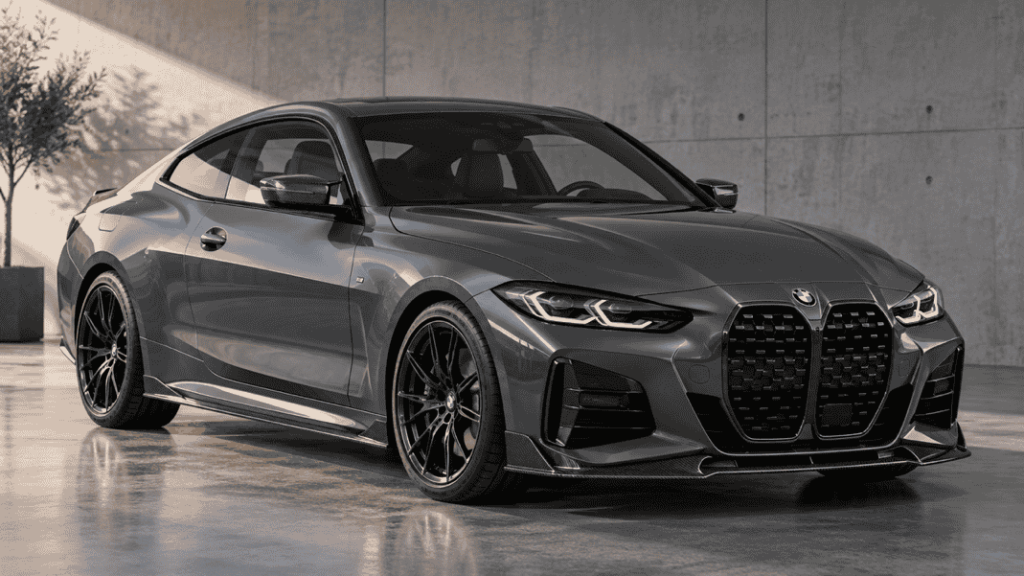
A custom carbon fiber prototype can be a single component, but its price often reflects much more than the material in that component. Tooling, CAD review, manufacturing method, labor, inspection, and design changes can all contribute to the initial investment. For automotive aftermarket brands, product developers, and wholesale buyers, understanding these costs before requesting a quote can prevent expensive surprises.
This guide explains how manufacturers approach custom carbon fiber prototyping costs, what information makes quotations more reliable, and how to plan a staged development program without sacrificing critical fitment and quality requirements.
1. What Does a Carbon Fiber Prototype Quote Actually Include?
A prototype quotation may cover only the fabrication of a part, or it may include the complete development package. These are not equivalent. Before comparing suppliers, ask what is included and which activities will be billed separately.
| Cost category | Typical activities | Questions to ask |
|---|---|---|
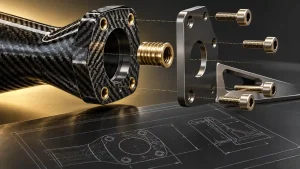
| Design review | Review of STEP/STP geometry, wall thickness, split lines, interfaces, and manufacturing feasibility | Is design-for-manufacture feedback included? |
| Tooling | Mold design, master patterns, mold fabrication, surface preparation, fixtures | Who owns the mold, and can it be reused? |
| Materials | Carbon reinforcement, resin or prepreg, consumables, inserts and bonding materials | Which fiber, resin, and cosmetic finish are specified? |
| Fabrication | Layup, bagging, curing, demolding, trimming, drilling and bonding | Which manufacturing process is being quoted? |
| Validation | Dimensional inspection, visual checks, assembly trials and agreed testing | Which checks are included, and what are the acceptance criteria? |
| Revisions and logistics | Design iterations, tool changes, packaging and shipping | How are changes and freight charged? |
One supplier may quote a sample using an existing mold, while another is pricing the creation of an entirely new mold. The sample prices may look dramatically different even when both quotations are reasonable for their respective scopes.
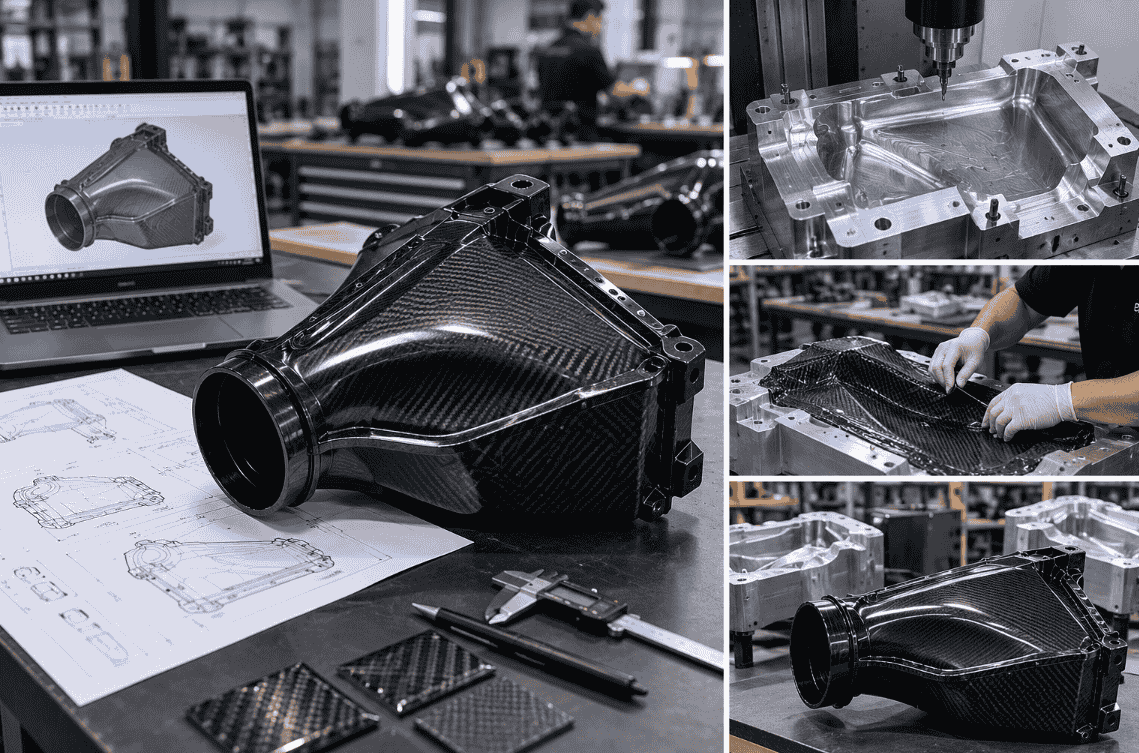
2. Seven Factors That Drive Custom Carbon Fiber Prototyping Cost
2.1 Geometry and manufacturing complexity
Large surfaces, deep cavities, undercuts, sharp transitions, narrow ducts, and hard-to-access internal features can increase tooling complexity and hands-on labor. A simple flat trim panel is generally easier to prototype than a multi-piece automotive airbox with removable covers and precision mating surfaces.
Designs created for machining or injection molding may need adjustments before they are suitable for composite layup. A STEP file is an important starting point, but it does not by itself define a feasible laminate construction.
2.2 Mold and tooling requirements
New geometry often requires dedicated tooling. Mold cost depends on size, shape, required finish, tool material, temperature exposure, expected reuse, and the number of tool sections. Additional jigs may be needed to locate mounting points or bond separate components accurately.
Ask whether tooling is intended for a single prototype, a small pilot batch, or repeat production. Lower-cost temporary tooling can be useful for early geometry checks, but may not deliver the same durability or repeatability as production tooling.
2.3 Material and finish specification
“Carbon fiber” is not one universal specification. Reinforcement architecture, fiber orientation, resin system, cosmetic weave, coating, and cure process all affect material use and manufacturing effort. A visible glossy twill surface has different cosmetic expectations from a non-visible functional enclosure.
Specify whether the product is primarily decorative, functional, or structural. Do not assume a visually attractive part meets load-bearing or thermal requirements without testing.
2.4 Process selection
Wet layup, vacuum-assisted processes, resin infusion, and prepreg processing have different equipment, material, tooling, and labor implications. The right choice depends on the design and performance targets, not simply on the cheapest nominal sample price.
2.5 Number of pieces and assembly interfaces
A prototype described as “one product” may contain multiple shells, covers, ducts, brackets, threaded inserts, gaskets, or bonded joints. Each component can require its own tooling and finishing operations. Interfaces between components add tolerance and fitment considerations.
2.6 Inspection and testing requirements
Basic cosmetic inspection is different from dimensional reports, trial fitting on a vehicle, heat-exposure assessment, leak checks, or performance validation. Request only the checks appropriate to the application, but document them before fabrication so that cost and responsibility are clear.
2.7 Revisions and project uncertainty
Unclear CAD data, missing mating dimensions, late design changes, or undefined finish standards can create repeated tool adjustments and new samples. These costs are often avoidable through an early design review and a controlled revision process.
3. How to Estimate Prototype Cost Without Guessing a Price
There is no reliable universal price for a custom carbon fiber prototype. A small cosmetic cover and a complex, multi-part engine-bay assembly can have fundamentally different cost structures. A useful starting point is to separate one-time development expenses from per-part production expenses.
Total initial project cost = design and feasibility work + one-time tooling + prototype fabrication + agreed inspection/testing + revisions + shipping.
Estimated effective cost per accepted prototype = total initial project cost ÷ number of accepted prototype units.
This is a planning formula, not a quotation or a statement of CCF pricing. Actual costs depend on drawings, specifications, and scope.
Why tooling changes the economics
Imagine a project with a hypothetical one-time tooling cost of $2,000 and a hypothetical fabrication cost of $250 per part, excluding engineering, inspection, revisions, and shipping. One sample would imply $2,250 before those exclusions; ten identical parts would imply $450 per part when the tooling is spread across ten units. These numbers are arithmetic examples only, not market benchmarks or CCF offers.
The practical lesson is that an initial sample price should not be compared directly with a repeat-order unit price. Conversely, ordering more units does not automatically solve an unvalidated design problem.
4. How Manufacturing Methods Affect Cost and Suitability
| Method | Potential advantages | Typical considerations |
|---|---|---|
| Hand wet layup | Flexible for certain early-stage shapes and low-volume work | Operator-dependent consistency; quality and resin control require attention |
| Vacuum-assisted wet layup | Can improve consolidation relative to uncontrolled open layup | Bagging consumables, leak management, and process discipline |
| Resin infusion | Can support controlled resin distribution for suitable geometries | Flow design, dry spots, tooling and setup complexity |
| Prepreg processing | Controlled incoming resin content and potentially high-quality laminates | Storage, cure requirements, tooling compatibility, and process cost |
No method is inherently best for every part. A capable supplier should match the process to geometry, required finish, mechanical and thermal conditions, quantity, and budget. For demanding functional components, agree on performance and validation requirements before selecting a process.
5. Prototype Development Versus Production Pricing
Prototype development and production have different objectives. Early prototypes help evaluate form, fit, and selected functions; pilot production checks repeatability and process stability; full production focuses on consistent delivery against approved specifications.
- Concept model: validates envelope and basic geometry; it may not use the final material or process.
- Fitment prototype: checks mounting locations, clearances, and component interfaces.
- Functional prototype: evaluates selected real-use requirements under a defined test plan.
- Pilot batch: assesses whether multiple parts can be produced consistently before scaling.
Be explicit about which stage you need. A cosmetic sample should not be treated as evidence that a heat-exposed intake component has passed functional testing.
6. Six Ways to Reduce Cost Without Increasing Project Risk
- Freeze critical interfaces early. Confirm vehicle mounting points, connection diameters, gasket surfaces, and mating geometry before cutting tools.
- Validate geometry before premium tooling. Where appropriate, use digital reviews, simple mockups, or fitment models to identify major issues.
- Separate cosmetic and functional requirements. Define which surfaces must be show-quality and which are hidden; avoid unnecessary finish work.
- Plan an integrated assembly even if production is phased. For a multi-part airbox, define the whole system before manufacturing individual shells or covers.
- Limit uncontrolled revisions. Use revision numbers, approval checkpoints, and written change requests.
- Request transparent quote line items. Separate tooling, sample fabrication, inspection, packaging, and freight to make supplier comparisons meaningful.
7. Example: Planning a Multi-Part Carbon Fiber Air Intake Project
Consider a hypothetical automotive intake assembly with a main enclosure, removable filter cover, connecting duct, brackets, and sealing features. Even if a buyer plans to prototype only the cover first, the entire assembly should be considered in the CAD review.
The manufacturer and buyer should define mating geometry, service access, fastener locations, thermal environment, sealing expectations, and which team is responsible for airflow or engine-performance testing. This avoids developing an attractive standalone component that cannot be integrated into the final system.
A sensible staged approach is to review the complete assembly, confirm interfaces, choose a low-risk first prototype, evaluate fitment, and then decide whether to proceed with remaining parts. The sequence should be adapted to the project rather than treated as a universal engineering procedure.
8. What to Include in a Carbon Fiber Prototype RFQ
A detailed request for quotation helps manufacturers identify feasibility issues and reduces follow-up questions. Where available, provide:
- 3D CAD files such as STEP/STP, with revision numbers, plus 2D drawings where critical dimensions and tolerances are defined.
- Part name, intended vehicle make/model/year, and installation environment.
- Overall dimensions, approximate quantity of components, and assembly relationships.
- Material, weave, resin, finish, and appearance expectations—or a request for the supplier to recommend suitable options.
- Functional requirements such as operating temperature, sealing, loads, and required validation.
- Prototype quantity, estimated future volume, and desired project milestones.
- Any existing molds, reference samples, fitment photos, and mounting-point measurements.
- Expected deliverables: sample only, dimensional report, test results, or other agreed documentation.
- Destination country and shipping requirements.
If the design is still preliminary, say so. A feasibility discussion is different from a firm production quote. Sensitive engineering files should be shared through an agreed secure process, with confidentiality terms where appropriate.
9. Questions to Ask Before Approving a Supplier Quote
- Does the quote include mold creation and any design adjustments?
- What assumptions were made about material, finish, tolerances, and process?
- How many samples and revisions are included?
- Who owns and stores the tooling, and what happens if the project pauses?
- Which inspections or tests are included, and who approves the results?
- What triggers additional charges or a revised delivery schedule?
- What changes when moving from prototype to repeat production?
Frequently Asked Questions
How much does one custom carbon fiber prototype cost?
There is no universal price. The scope may include one-time tooling, CAD review, materials, fabrication, finishing, inspection, and revisions. A supplier needs the design and specifications to prepare a meaningful quotation.
Why is the first sample more expensive than later units?
The first sample may absorb one-time mold and setup costs. Repeat parts can reuse approved tooling, although fabrication, inspection, and other per-unit expenses remain.
Can a STEP file be used to quote a carbon fiber prototype?
Often it is a useful starting point. However, critical tolerances, laminate requirements, finish, assembly conditions, and performance expectations may need additional drawings or clarification. Read our STEP file manufacturing guide for more details.
Can I make a prototype without paying for a production mold?
Some projects can use temporary tooling, simplified models, or alternative validation methods. Whether these are suitable depends on geometry, required accuracy, finish, and what the prototype must prove.
Does a successful fitment sample mean the part is production-ready?
No. Fitment is one validation dimension. Depending on the application, repeatability, material properties, thermal exposure, durability, sealing, and other performance requirements may still need verification.
Should I prototype every component at once?
Not necessarily. Staged prototypes can reduce early investment, but interfaces and system-level requirements should be designed together to avoid incompatible parts.
Can tooling costs be shared across future orders?
One-time tooling costs can be amortized over a planned production quantity for cost analysis. Actual ownership, reuse, storage, and commercial terms must be agreed with the supplier.
Conclusion: Compare Development Scope, Not Just Sample Price
The most useful prototype quote is not automatically the lowest one. It is the quote that clearly defines what will be manufactured, what assumptions apply, what is being validated, and what happens if the design changes. For automotive carbon fiber projects, early clarity about tooling, fitment, material specifications, and engineering responsibility can save more than an aggressive sample-price negotiation.
Discuss a Custom Carbon Fiber Project with CCF
Have a STEP file, technical drawing, or reference sample? Share your part details, intended application, prototype quantity, and expected production volume with CCF to discuss manufacturing feasibility and quotation requirements. Engineering and testing scope can be clarified during project review.
Explore Wholesale & Custom ProjectsRelated Resources
Editorial note: Cost examples in this article are illustrative only. Specifications, capabilities, commercial terms, and pricing must be confirmed for each project.