For distributors and brands buying carbon fiber parts in bulk, factory records are useful only when they connect to the stock you receive and resell. Agree with the manufacturer which identifiers and documents can accompany a wholesale order before promising traceability to your dealers.
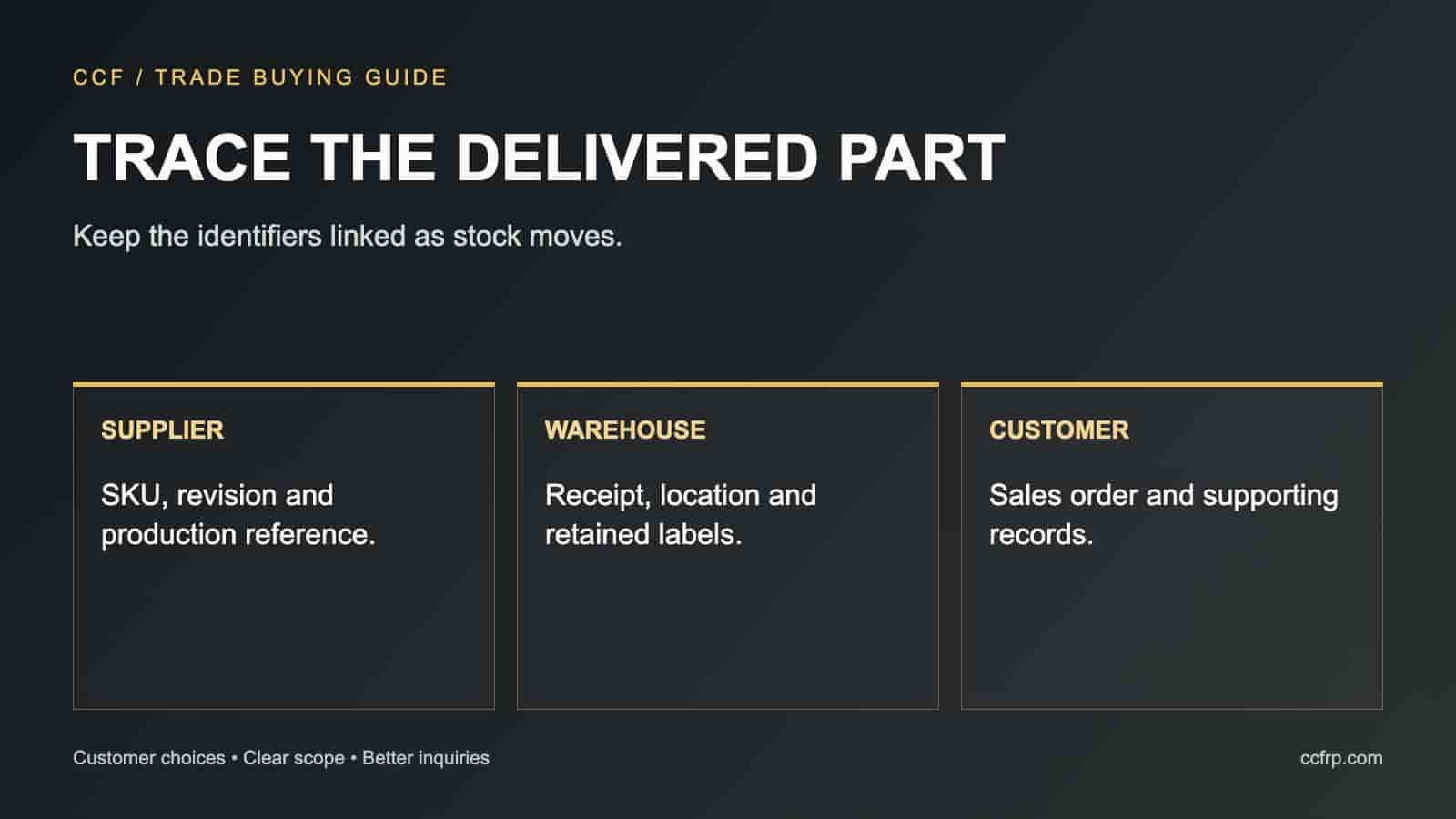
Useful carbon fiber parts batch traceability connects a delivered part to its product version, production reference, inspection records and customer order. A batch number without those connections is only a label. Dealers should agree which records are available and preserve the links when receiving, storing and reselling the parts.
This is a recommended purchasing workflow, not a claim that every supplier or CCF order already uses a particular traceability system. Request the available record scope before making traceability promises to your own customers.
Define what you need to retrieve
Start with an ordinary business question: if a customer reports a fitment difference six months later, can your team identify which version was supplied? A useful record should distinguish a design revision from a new production batch and distinguish both from your sales order.
A SKU identifies a product in the agreed catalog. A revision distinguishes a documented change to that product. A batch reference groups production according to the supplier’s system. An order identifies a commercial transaction, which may contain more than one batch. Ask the supplier how these identifiers work instead of assuming they mean the same thing.
Records to agree with your manufacturer before a bulk order
| Field | Illustrative entry | Purpose |
|---|---|---|
| Supplier reference | EX-LIP-A | Identify the ordered product |
| Revision | Rev B, if the supplier uses revisions | Separate documented product changes |
| Production reference | Example batch LOT-042 | Connect the supplied production group |
| Purchase order and line | PO-EXAMPLE, line 2 | Locate the accepted commercial scope |
| Inspection reference | Report EX-042 and approved sample record | Retrieve the relevant acceptance evidence |
| Receiving and sales reference | Receipt EX-17; dealer order EX-88 | Follow the part after it enters your stock |
These entries are fictional examples, not CCF batch codes or inspection records. Replace them with the identifiers actually supplied. If a field is unavailable, record that limitation and agree an alternative rather than inventing a code that appears to come from the factory.
Preserve the connection when cartons are split
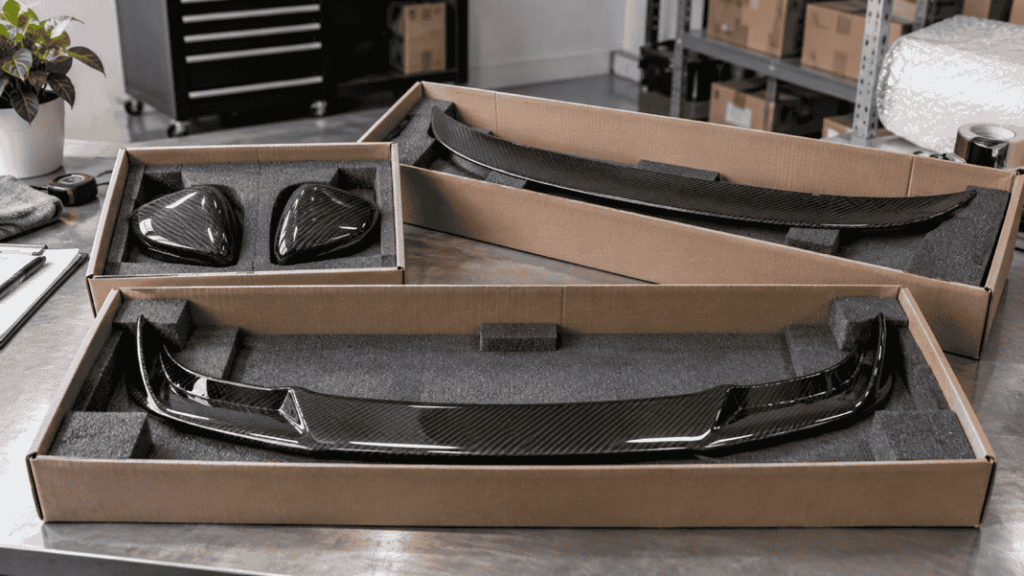
A mixed-model carton may be unpacked into several storage locations. Photograph and retain the supplier labels, then attach your internal receiving reference to the relevant stock record. If individual parts do not have unique identifiers, document the level of traceability you can actually maintain.
Do not claim item-level history when your records only identify a carton or batch. If batches are mixed in one bin without recording which parts were sold, later identification may be uncertain. Keep them separated where batch distinction matters to your agreed process. The warehouse SKU-labeling guide covers everyday storage identification.
Connect sample approval to production without overstating it
An approved sample establishes an agreed reference within its defined scope. It does not demonstrate that every subsequent item was individually tested. Keep the sample reference and the supplier’s stated production inspection scope distinct.
The sample inspection checklist helps define acceptance criteria. This traceability record should point to that approval rather than duplicating photographs in multiple disconnected folders. Where a report covers a sample from a batch, retain its stated sampling scope.
Use the records to manage a concern
If a buyer reports an issue, first identify the part, order and available production reference. Preserve the customer’s description and photographs separately from your interpretation. Compare the supplied version with the approved scope and ask the supplier what other records are available.
Do not assume every part in the batch is defective, or that every other batch is unaffected. Hold or inspect stock as appropriate to the issue and supplier guidance. The purpose of traceability is to narrow the investigation and support a reasoned action, not to replace technical assessment.
Make reorders explicit
Include the previous product reference and revision in the reorder request. Ask whether construction, finish, hardware or packaging has changed. If a change is proposed, update the agreed specification before reusing old listing claims or customer photographs. See the wholesale reorder guide for the wider commercial checklist.
Set a record-retention approach that matches your contractual obligations and business needs. Keep customer contact data access-controlled; technical traceability does not require exposing personal information in shared product folders.
Agree the factory-to-distributor record handover
Ask which records will be available before dispatch, which arrive with the shipment and who can retrieve them later. For an OEM or private-label program, connect your own product code to the manufacturer’s reference so relabeling does not break the record. Agree the scope in writing; do not assume a factory certificate or batch-level report provides individual-part history.
Questions buyers ask
Do we need expensive software?
Not necessarily. A controlled spreadsheet with stable file references can support a small operation, provided receiving and sales teams maintain the connections.
Is a QR code enough?
Only if it resolves to the correct, maintained information. The code itself does not establish what was made or inspected.
What should we request from CCF?
Ask which product, production and inspection references can be supplied for the selected order, in what format, and at what stage. Agree the scope before promising it downstream.
Source automotive carbon fiber parts from CCF
CCF manufactures automotive carbon fiber parts for tuning shops, distributors and aftermarket brands. Discuss record availability with your selected products through CCF wholesale purchasing. Include additional program requirements in an OEM/ODM project brief.
Discuss Your Wholesale Order Records
Send the SKU list, quantities and the records your business needs for receiving, resale and reorders. Ask CCF to confirm the available documentation scope for that order.
Send an Inquiry
Include your company, product reference, quantity, destination and wholesale or OEM requirements.