Running out of a proven part can lose a customer job. Ordering too early can tie up cash in vehicle-specific stock that moves slowly. A dealer needs a repeatable trigger, not a reminder based only on how empty the shelf looks.
Set a carbon fiber reorder review point using expected demand during replenishment, a deliberate buffer and the stock already available or confirmed inbound. Use it as a decision aid; uncertain supply and irregular demand still require judgment.

Concept illustration.
Count usable stock correctly
Separate sellable units from display samples, damaged items, reserved customer orders and unverified returns. Count in the SKU's sales unit: a pair of side skirts is not two independently sellable sets.
Then list confirmed inbound quantities and their expected readiness or arrival scope. A purchase request awaiting confirmation is not equivalent to stock already dispatched. Keep overdue or uncertain inbound supply visible rather than letting it hide a shortage.
Use a simple review calculation
A basic planning approach is:
Review point = expected demand during replenishment + chosen buffer.
Planning stock position = sellable stock + usable confirmed inbound supply − quantities already committed.
Compare the two using consistent sales units and dates. If your sales history already excludes reserved demand in a different way, adjust the method so the same customer order is not counted twice.
| Illustrative input | Example only |
|---|---|
| Expected sales | 2 sets per week |
| Planning replenishment interval | 3 weeks |
| Demand during that interval | 6 sets |
| Chosen buffer | 2 sets |
| Review point | 8 sets |
| Sellable stock + confirmed inbound − commitments | 5 + 2 − 1 = 6 sets |
In this invented example, 6 is below the 8-set review point, so the dealer should review replenishment. It does not automatically mean ordering two sets is sufficient; the order quantity depends on the desired coverage after arrival, purchasing constraints and cash available. These numbers are not CCF lead times or recommended stock levels.
Handle new products differently
A new SKU has little dependable sales history. Start with inquiries, actual paid orders and your existing customer base, while keeping those signals separate. Do not convert every social-media question into a forecast sale.
For uncertain demand, a focused trial or eligible individual fulfillment can provide evidence before deeper stock. The BMW range planning guide helps determine which applications deserve attention in the first place.
Review the assumptions when conditions change
Revisit the trigger when supply timing changes, a major customer project is booked, a product version changes or recent demand becomes less representative. Long exterior parts can consume storage and shipping budget differently from small trim, even when unit sales are similar.
Discuss readiness and delivery stages using the lead-time guide. Before placing the repeat order, confirm the version, finish and hardware through the reorder consistency checklist.
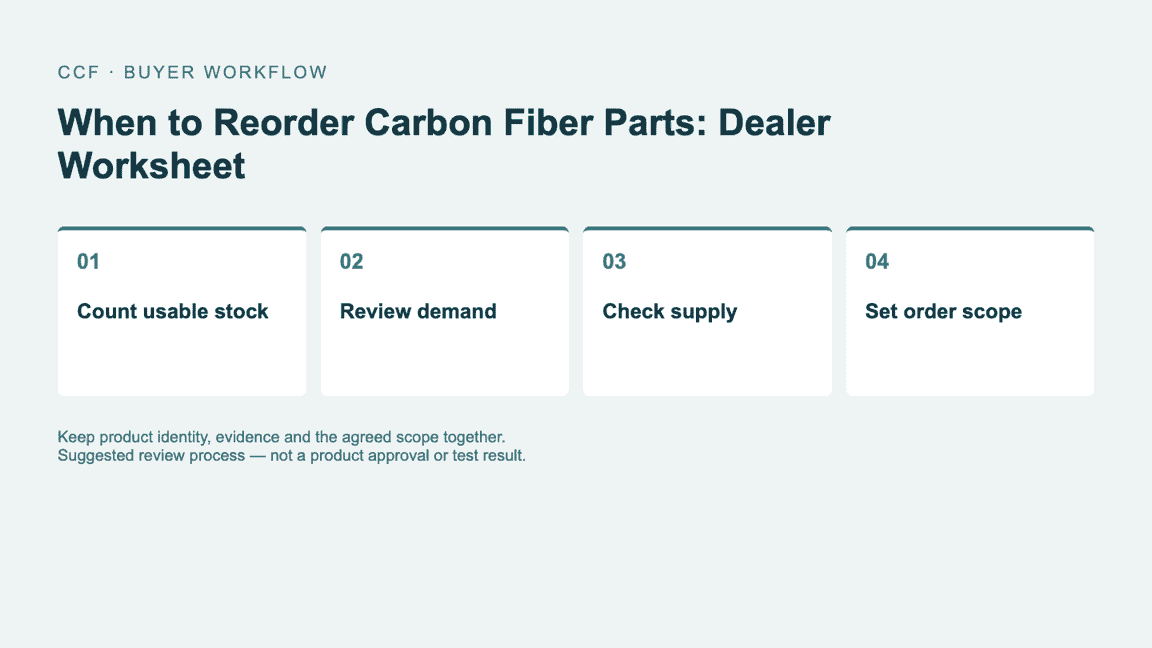
Suggested buyer workflow. Follow the product-specific specification and agreed order terms where applicable.
Use the worksheet without confusing trigger and order quantity
The earlier example triggers a review at eight sets. The following continuation is hypothetical and demonstrates why the trigger is not automatically the purchase quantity.
| Record | Example or required entry |
|---|---|
| Position now | 5 saleable + 2 usable inbound − 1 committed = 6 sets. |
| Expected uncommitted demand before new supply | 6 sets; assumed separately from the one order already deducted. |
| Projected available position at arrival | 6 − 6 = 0 sets, assuming the existing inbound stock arrives in time. |
| Desired stock after arrival | 10 sets for this illustration only. |
| Provisional purchase quantity | 10 − 0 = 10 sets, before MOQ, timing and cash constraints. |
If the existing inbound two sets miss the required window, recalculate rather than treating them as available. Copy these five rows into your stock review and record the assumptions beside the result. No number in this example is a CCF lead time, MOQ or recommended stock target.
Try the replenishment worksheet
Editable hypothetical example. Use consistent units and replace the example inputs with your own records. Values stay in this browser and are not submitted to CCF.
Change the inputs, then select Calculate. The worked example above also provides the calculation if scripts are unavailable.
Questions buyers ask
Should I set one reorder level for every product? No. Sales units, demand patterns, supply uncertainty, storage requirements and customer commitments differ by SKU.
Does a buffer eliminate stockouts? No. It is a planning choice, not a guarantee. Record why you selected it and review it against actual results.
For the related buying decisions, see Carbon Fiber Dropshipping for Dealers: What to Confirm Before Taking Customer Orders and When a Carbon Fiber SKU Is Unavailable: How Dealers Should Approve Alternatives.
Reorder from a product list, not a guess
Send CCF the SKU, current quantity requirement and required delivery window. Ask for the current supply position before relying on a previous order's timing. A realistic replenishment decision begins with current product information.
Send an Inquiry
Include the article title, selected parts, quantity and delivery country.