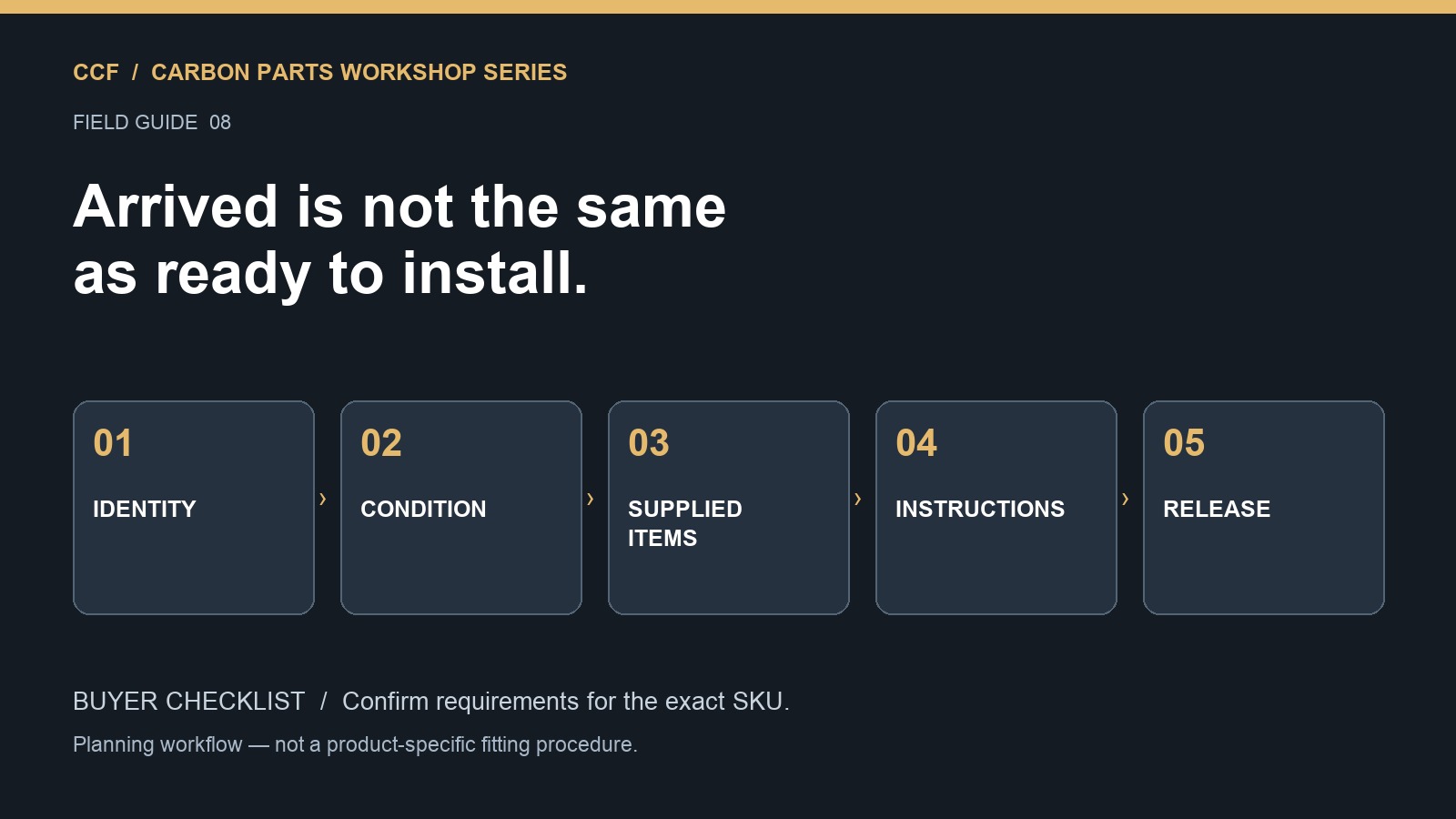
CARBON PARTS WORKSHOP SERIES · 08
A Golf R MK7 diffuser should be released to the workshop only after its identity, delivered condition, supplied contents and applicable installation information have been checked. Opening an undamaged carton is a receiving milestone, not confirmation that the product is ready for the customer’s vehicle.
This Carbon Parts Workshop Series article gives dealers and tuning shops a practical arrival process. It keeps three decisions separate: accept the shipment condition, confirm the agreed package and approve the installation scope.
Confirm the Golf variant before opening a job
Record the customer’s model year, market, bumper configuration and relevant modifications. Keep Golf R, GTI and facelift distinctions explicit. Do not use a familiar Golf silhouette or an abbreviated warehouse label as proof that the application is correct.
Match the supplier SKU to the confirmed order. If a listing covers several variants, ask which part was selected for this customer and which document applies. A manual headed MK7 Golf R is not enough to establish MK7.5 or GTI compatibility. The application needs to be confirmed for the actual product.
What the ECS example illustrates
ECS Tuning’s MK7 Golf R diffuser document identifies ES3985143 and describes supplied brackets as part of its installation. It provides a concrete example of why an attractive outer panel is not the whole installation package.
This reference applies to the ECS product it identifies. It does not establish the brackets, fasteners or sequence required for a CCF diffuser. Use the example to improve your receiving questions, then obtain product-specific information for the ordered part.
Run three checks, with three separate results
| Check | Record | What it does not prove |
|---|---|---|
| Shipment condition | Carton condition and visible condition of the delivered part | Vehicle compatibility or completeness of the installation system |
| Package agreement | SKU, quantity and contents compared with the accepted order | That the workshop has every separately required item |
| Installation readiness | Installer review of application, instructions and unresolved questions | Completed fitting or validated vehicle performance |
A pass in one column should not automatically fill the other columns. A cosmetically good part may arrive with a package question. A complete shipment can still require clarification of the vehicle application.
Inspect against the agreement rather than an imagined standard
Photograph the product label, visible surfaces and relevant mounting areas. Compare the delivered pieces with the accepted packing list. Count the supplied installation items without assuming that every product uses the same hardware. Record any observed discrepancy in neutral terms.
The sample inspection guide helps structure the evidence. For repeat wholesale orders, retain the approved sample record and note any supplier-confirmed revision. A difference from the sample deserves clarification, but do not assign a cause before the product has been identified.
Create a short exception report
Use a report that names the order reference, SKU, observed difference and action needed. For example: “The packing list identifies a mounting component that is not present in the package photographs. Please confirm whether this shipment is incomplete or the package specification has changed.” This is a hypothetical example, not a claim about ECS or CCF shipments.
A precise report gives the supplier a question to answer. “Does not fit” is premature when the issue is a missing item or uncertain product identity. If there is an actual interface concern, use the fitment problem evidence checklist to document it before modifying the product or vehicle.
Keep the car’s current rear configuration in the file
Ask about existing diffusers, changed exhaust outlets, bumper replacements and relevant previous work. Give the installer current photographs and the supplier’s application statement. Do not assume that the customer’s model description captures all changes that could affect the job.
The installer should compare that information with the requirements of the selected product. This article does not supply a universal clearance value, clip arrangement or removal method. Those details must come from the correct product and vehicle information.
Agree the workshop release conditions
A useful release record identifies who checked the delivery, which instruction was provided and which open items were resolved. Ask the installer whether the available information is sufficient to confirm the work. If an issue remains, identify its owner and the next action instead of placing the carton beside the vehicle and assuming the technician will solve it.
Use the installation quote framework to distinguish a provisional estimate from confirmed scope. If an item is delayed, discuss the booking implications before the customer arrives.
Keep repeat orders traceable
For distributors, connect the installation information to the shipped SKU and revision. Avoid relying only on a mutable web listing. If the supplier updates the package, ask which stock or shipment is affected and whether the previous instructions remain applicable.
The dealer product data guide provides a structure for retaining this information. That record also helps when a downstream shop asks for a replacement component or clarification after the original sale.
Frequently asked questions
Can a warehouse approve installation readiness?
The warehouse can check the received order against its records. The installer should review the application and work requirements before the job is released for installation.
Does an intact package mean I should book the customer immediately?
Complete the identity, contents and document checks first. Shipment condition alone does not settle the installation scope.
Can the same checklist be used for another Golf version?
The receiving process can be reused. The product application, hardware and instructions must be checked separately for the other version.
Request a clear diffuser package
Send CCF the exact vehicle details, rear photographs, preferred diffuser reference, quantity and destination. Ask which product and package can be confirmed for the enquiry and what information can accompany the shipment for your receiving team and installer.
Editorial reference check: 18 October 2026. Referenced manufacturer documents apply to their identified products. Confirm CCF SKU requirements separately.