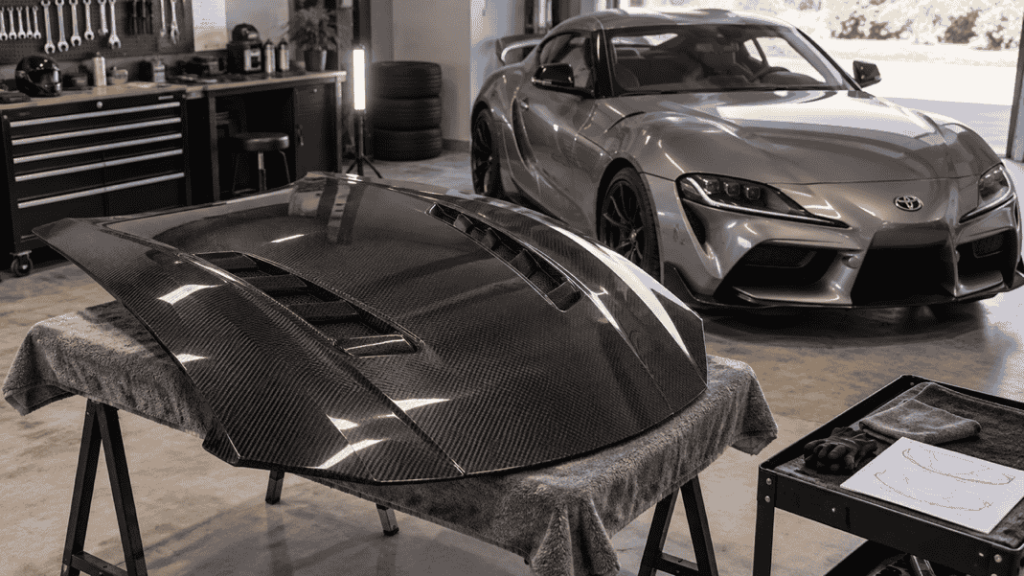
For tuning shops sourcing from a carbon fiber parts manufacturer, mounting information belongs in the pre-order discussion. Ask the supplier what hardware and interface guidance will be available before committing to a wholesale purchase or booking customer installation work.
Carbon fiber not rusting does not mean a carbon-fiber-to-metal connection needs no corrosion review. When conductive carbon and a susceptible metal are electrically connected in the presence of an electrolyte, galvanic corrosion can be a concern. Shops should ask how the selected product’s mounting interface addresses contact, moisture and maintenance.
This is a purchasing and handover checklist. It does not prescribe a universal washer, isolation thickness, adhesive or tightening torque. Those choices must suit the specific assembly and its installation requirements.
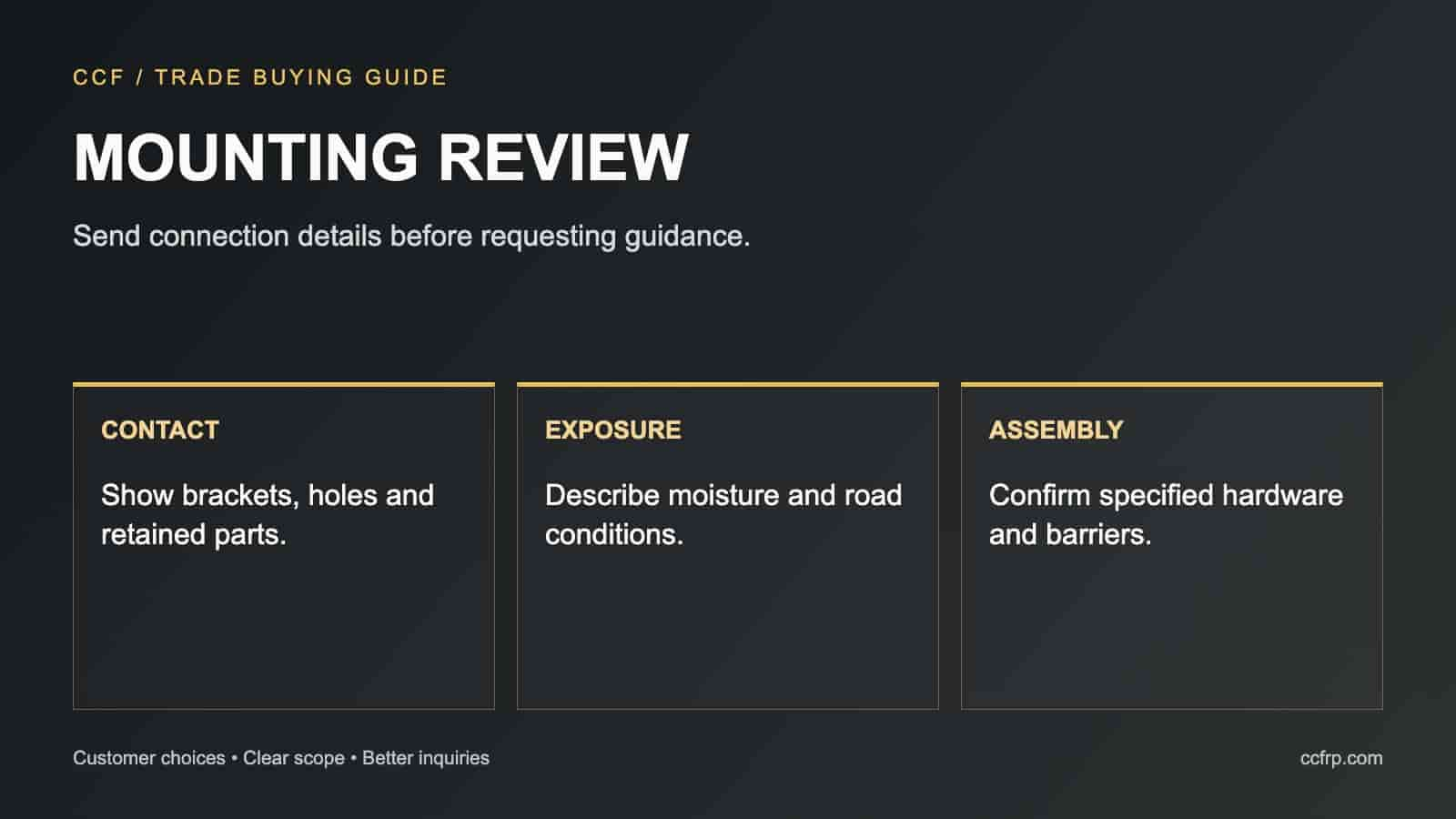
Review the connection, not only the visible panel
Look at the underside, mounting holes, brackets, inserts and any metal hardware that will remain on the vehicle. Identify what the new part contacts and whether existing coatings or protective features are involved. Ask for underside photographs before ordering if the listing only shows the finished face.
Do not assume that a glossy clear surface electrically isolates every mounting location. Nor should a shop remove or add interface layers without knowing their role. The required assembly information should identify the relevant components and their placement.
Understand the corrosion question without oversimplifying it
Toray’s T700S data sheet reports electrical resistivity for the fiber; carbon reinforcement should not be treated as inherently nonconductive. Easy Composites’ resin-infusion guidance also identifies carbon/aluminium contact in saltwater as a galvanic-corrosion concern. These references explain why contact and exposure deserve review, not whether a particular CCF installation will corrode.
Actual exposure, material pairing, surface protection and connection design matter. “Carbon does not rust” is therefore an incomplete answer when the buyer is asking about a metal fastener or bracket.
Send the manufacturer an interface brief before ordering
| Information | What to provide or request |
|---|---|
| Product identity | Selected SKU, revision and intended vehicle configuration |
| Contact locations | Numbered photographs showing the relevant holes, brackets or contact faces |
| Existing assembly | Known hardware and retained components; mark unknown materials rather than guessing |
| Exposure | Road use, wet conditions, road-salt exposure or other relevant conditions |
| Supplied protection | Specified coatings, barriers or interface components and their intended placement |
| Installation information | Approved hardware and product-specific assembly instructions |
Why a generic washer recommendation is insufficient
A shop may be tempted to add a soft washer wherever carbon meets metal. But changing a connection can also change its geometry, clamping behavior or hardware engagement. Ask the product supplier or responsible engineer to identify a suitable arrangement rather than treating any separating material as interchangeable.
The same applies to adhesive suggestions. A published bond-strength result depends on the tested substrates, preparation and conditions. It does not establish that the adhesive is suitable for every automotive interface. Use the trim adhesive selection guide for the information needed before requesting a specific method.
Separate purchasing checks from installation decisions
Before ordering, confirm what mounting information and supplied hardware will be available. Before installation, the workshop should review that information against the actual vehicle and any modifications. If a required instruction is missing or the physical interface differs, stop that assembly step and request clarification before drilling, enlarging holes or substituting hardware.
For custom development, the threaded-insert specification guide addresses upstream design questions. This finished-part checklist focuses on the assembly delivered to the workshop.
Keep useful handover records
Record the product reference, installed hardware and any approved deviations. Photograph relevant connection areas while accessible. Give the customer the applicable care and inspection guidance, including any supplier-defined follow-up. Do not invent a universal inspection interval for all carbon parts.
If a later concern develops, preserve photographs and assembly records before cleaning away evidence or making changes. The batch-record guide helps connect the installed part to the supplied version and order.
Include mounting information in the wholesale handover
When ordering several references, ask the supplier to identify instructions and hardware by SKU. A generic factory installation note may not cover each part. Distributors should preserve that connection when passing information to fitting shops. For an OEM design, unresolved connection requirements belong in engineering review before production approval, not in a last-minute note to the installer.
Questions buyers ask
Does carbon fiber rust like steel?
No, but that does not settle the condition of adjacent metal or the durability of the entire joint.
Will any coating prevent galvanic corrosion?
Do not assume so. Suitability and continuity at the actual interface require application-specific consideration.
Can CCF confirm an installation from one front-view photograph?
A front view usually does not show the connection. Send the product reference, vehicle details and clear interface photographs so the available guidance can be checked.
Technical references
Toray T700S material data; Easy Composites resin-infusion guidance and technical questions.
Source automotive carbon fiber parts from CCF
CCF manufactures automotive carbon fiber parts for tuning shops, distributors and aftermarket brands. For catalog supply, include these questions in a CCF wholesale inquiry. For a newly developed connection, discuss the design scope through OEM/ODM project review.
Ask for Product-Specific Mounting Information
Send the SKU, vehicle configuration, interface photographs and intended order quantity. Ask CCF which mounting information is available for the selected product before scheduling installation.
Send an Inquiry
Include your company, product reference, quantity, destination and wholesale or OEM requirements.