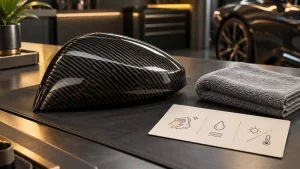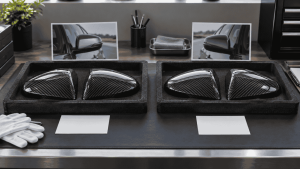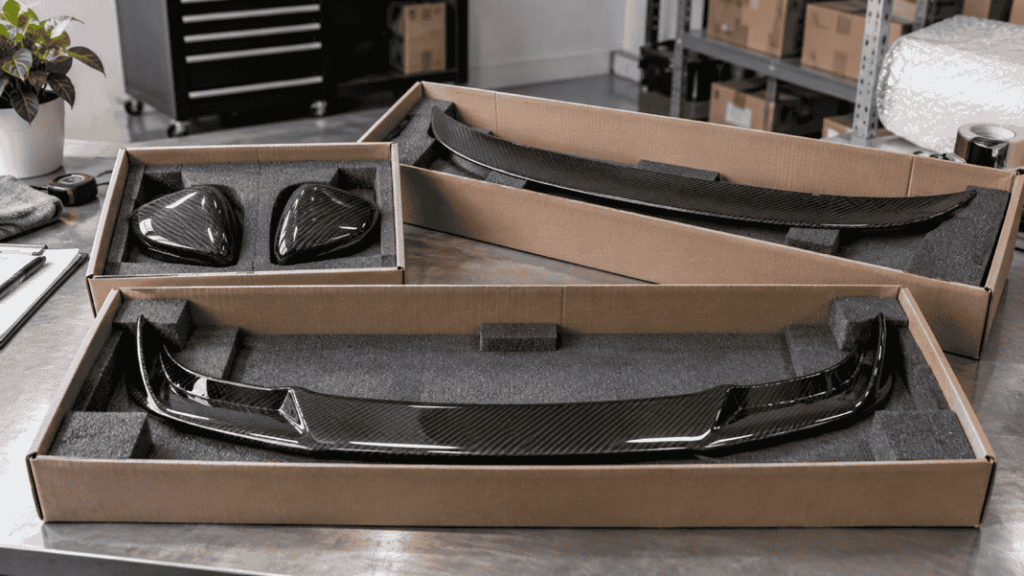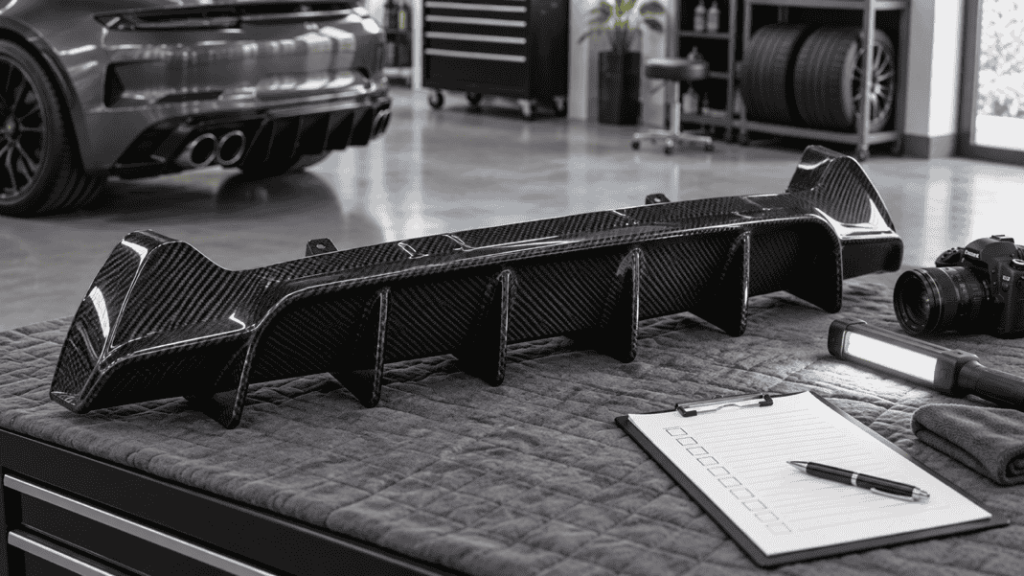
Identical listing photos do not prove that two carbon fiber suppliers offer the same mold, laminate, hardware or support. Give each supplier the same vehicle and product brief, then compare the evidence and quoted scope line by line. This approach helps buyers explain a price difference without assuming either offer is equivalent or inferior.
This guide focuses on one common sourcing problem: two listings look almost identical, but the quotations do not. It is not a brand ranking. The method works whether you are buying a single evaluation sample or planning a mixed-model wholesale order.
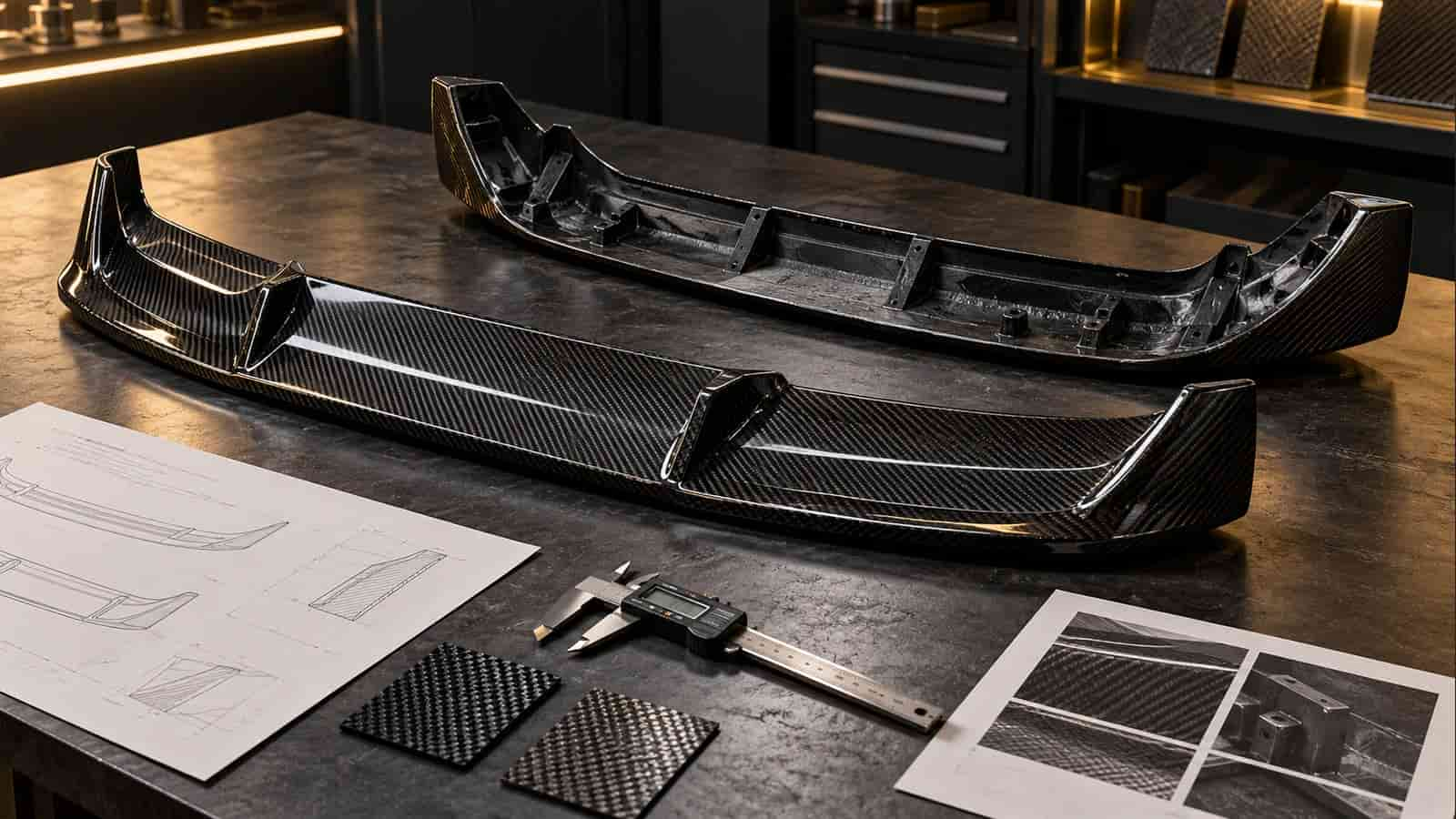
Why matching images are only a starting point
A photograph may show a previous sample, a shared reference or a product sold through more than one channel. It can also omit the reverse side, brackets, mounting surfaces and accessory pack. None of those possibilities can be resolved by comparing the front view alone. Ask each supplier what the image represents and whether the quoted version is the one pictured.
Do not move from “the images match” to “the products must be identical.” Equally, do not assume that a more expensive offer is necessarily better. A price difference becomes meaningful only after the delivery scope and evidence are comparable. Your decision should survive being explained to the installer who has to fit the part and the customer who will use it.
Send both suppliers the same buying brief
Start with the customer’s vehicle model, production year, body version and relevant bumper or trunk configuration. Include photographs of the actual mounting area and disclose existing modifications. Add the required style, finish, quantity, destination and sales unit: one piece, a pair, a multi-piece assembly or a complete kit.
Keep the brief separate from a competitor’s listing. A supplier should identify its own product code and version, rather than simply confirm that it can supply “the same.” Save the response with a date. If a sample is approved later, that sample needs to remain traceable to the quotation and subsequent order.
The broader wholesale quotation comparison guide explains how to align freight and commercial scope. Use the following table first to align the product itself.
A like-for-like product evidence table
| Comparison field | Ask each supplier for | What a mismatch means |
|---|---|---|
| Exact application | Written vehicle and body-version scope | Similar appearance may hide different interfaces |
| Product identity | SKU, version and current sample photographs | You may be comparing different revisions |
| Construction | Substrate, visible carbon coverage and manufacturing description | “Carbon fiber” alone is not a full specification |
| Mounting interface | Reverse-side and mounting-area views | A front photograph cannot establish installation scope |
| Supplied contents | Itemized parts and hardware list | A lower price may cover fewer items |
| Finish | Finish description and sample approval process | Color, weave appearance and gloss expectations may differ |
| Order support | Inspection, issue-reporting and remedy terms | The transaction may carry different operating costs |
Treat an unanswered cell as unresolved, not as a failed product. A supplier may need time to obtain a detail. What matters is whether the uncertainty is closed before you make a promise to your customer.
Ask for evidence that answers a particular question
“Send more photos” often produces more front views. Instead, request a continuous short video showing the sample identifier, front, reverse side, mounting areas and included accessories. Ask the supplier to explain any difference between the listing and the current sample. This gives the review a defined purpose without pretending that video replaces physical evaluation.
For an appearance-sensitive order, agree how you will assess the sample: viewing distance, lighting, which surfaces are customer-visible and how discrepancies will be recorded. A phone image can assist a conversation, but it does not create an objective color standard. The sample inspection guide provides a useful framework for turning observations into an approval record.
One approved sample also does not prove every future shipment will be identical. Ask how the approved specification will be referenced on repeat orders and what happens if the product changes. That question is more useful than asking for an unsupported “100% same quality” promise.
Compare operational cost without inventing a defect rate
A shop’s acquisition cost includes more than the supplier’s part price. There may be separate hardware, freight, import charges, inspection time or finishing work. Keep confirmed charges apart from uncertain costs. Do not invent a percentage of expected defects just to make one quotation look better.
Consider a hypothetical comparison. Offer A lists a front lip only; offer B lists the lip plus a documented hardware pack. Before selecting either, ask whether A needs separately purchased hardware, whether B’s hardware is correct for the vehicle, and what the installer requires. The example does not prove B is cheaper overall. It shows why the invoice total is not yet a like-for-like comparison.
If an installation issue occurs, clarify the reporting route and what may be modified while the claim is assessed. Read carbon fiber parts warranty questions before assuming that a replacement part also covers removal, paintwork or workshop labor.
Use three decisions instead of a vague supplier score
A simple decision record is easier to defend than an arbitrary score out of 100. Mark each offer as ready for a sample, waiting for clarification or unsuitable for this application. Explain the specific reason. For example, “waiting for reverse-side photographs and confirmation of brackets” is actionable; “quality seems low” is not.
Proceed to a sample when the identity, application and order scope are sufficiently clear for evaluation. Hold a bulk commitment when the supplier cannot identify the version being quoted, when sample and listing information conflict, or when installation requirements remain unresolved. Broader business checks belong in your manufacturer verification process, not in a photograph comparison alone.
Copy this request into your sourcing brief
Please identify the SKU and version you are quoting for our vehicle configuration. Confirm construction, finish, supplied contents and any separately required installation items. Provide current front, reverse-side and mounting-area photographs, and explain whether they show the quoted version. Please separate sample terms, quantity pricing, packing, lead time and delivery scope. Identify any application or installation details that still require confirmation.
Attach your vehicle photographs and quantity rather than sending an unexplained screenshot. You are more likely to receive an answer that your purchasing and installation teams can use together.
Frequently asked questions
Do identical photos prove the same factory makes both parts?
No. The image alone cannot establish the production source or whether the quoted products share a specification. Ask for product identification and current evidence, then evaluate the sample and commercial scope.
Should I always choose the more expensive carbon fiber supplier?
No. Choose an offer whose specification, evidence and terms meet your requirements. A price premium without a defined benefit is not a substitute for verification.
Can a small sample order settle the comparison?
It can answer questions about the sample supplied and its application. Record what you inspected and what remains untested. Use that approved reference and written specification when discussing a larger order.
Get a comparable offer for your next build
Send CCF the vehicle details, reference style, quantity and destination. Ask for a product-specific trade quotation and the information still needed to compare it fairly. Resolve the scope before committing customer money to a product that merely looks the same.
Send Your Product Enquiry
Include your company, vehicle details, product reference, quantity and destination.