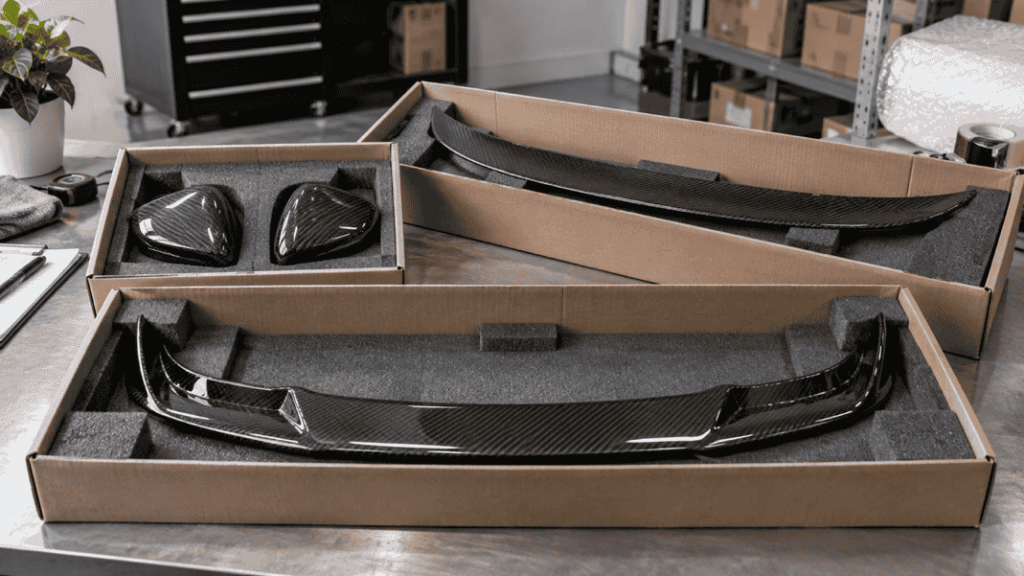
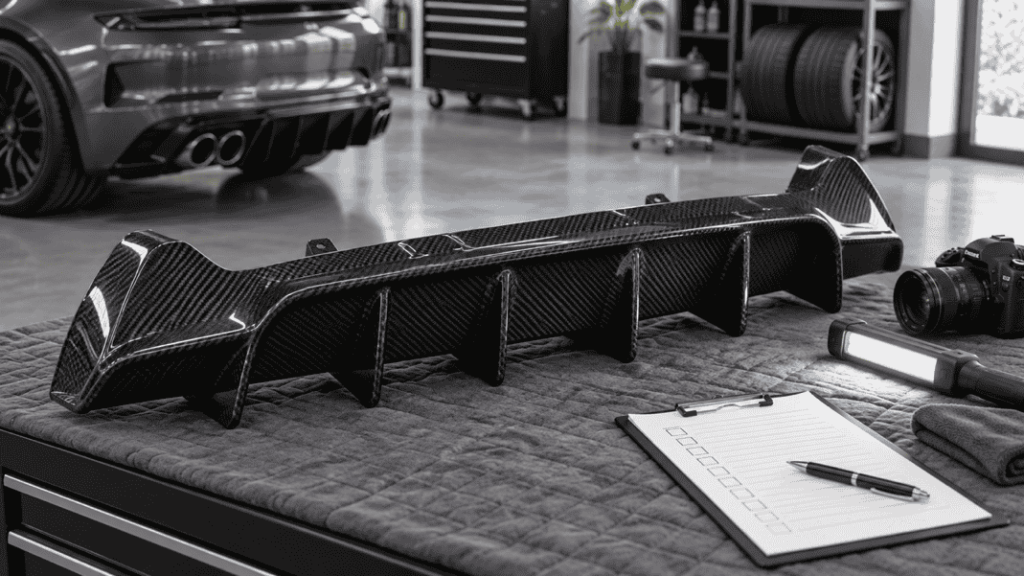
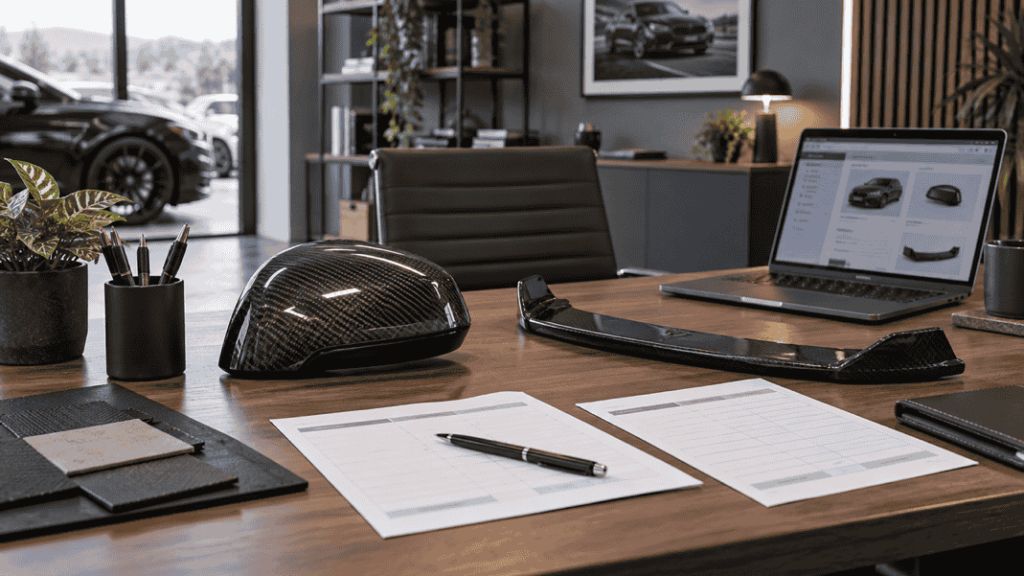
A wall full of carbon parts can look impressive while doing little to answer a customer's buying questions. A smaller, well-labeled set can help your staff explain appearance, product type and the information needed to place the correct order.
Choose carbon fiber display samples around the vehicles you serve and the decisions customers struggle with. Every display item should connect to a known product reference or be clearly labeled as a material or concept sample.
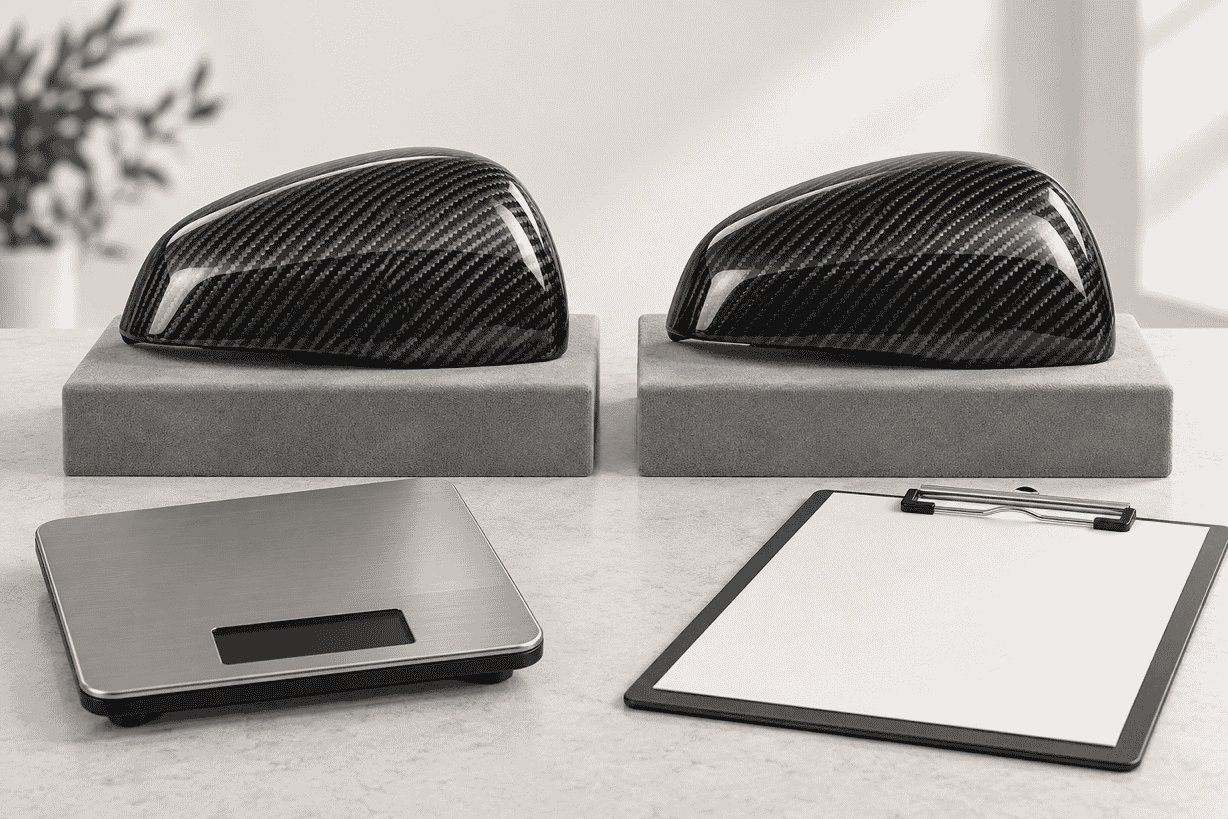
Concept illustration.
Give each sample a job
Use one sample to demonstrate visible finish, another to explain an interface, and another to discuss a relevant product type. Avoid buying several visually similar pieces unless the differences are something your customers genuinely need to compare.
For example, a mirror-cap sample can show the difference between the visible face and rear attachment area. A lip section can help explain that a multi-piece assembly has specific joining requirements. Neither should be presented as proof that all catalog products share the same construction or fitment.
Build a focused display record
| Display element | What the label or sales record should say |
|---|---|
| Orderable product sample | Product reference, version and actual sales unit |
| Material/finish sample | What it illustrates and what it does not represent |
| Rear-interface view | Which product it belongs to |
| Installed photograph | Identified vehicle/product where known; additional parts excluded |
| Customer takeaway | Relevant product page or inquiry reference |
| Review date | When the display information was last checked |
Keep current availability separate from physical possession of a sample. A display piece is not evidence that the same version is ready for immediate dispatch.
Teach the sales team the limits
The sample should support precise explanations. “This piece lets you inspect the visible weave and surface” is better than “everything we sell looks exactly like this.” If the customer is matching existing trim, request the relevant comparison evidence for the actual order.
Use the dry-versus-wet-carbon guide to separate manufacturing language from appearance. Do not claim a process, weight saving or performance result merely by pointing at a glossy sample.
Turn handling into a better inquiry
After the customer chooses an appearance, collect the vehicle information and the exact part wanted. The sample may have served as a visual reference rather than the product being ordered. Record that distinction on the quote request.
If you use a QR code, link it to a maintained product or inquiry page, not a temporary file that can disappear. Check that the destination makes the sample identity and next step clear. A sales tool is only useful if it leads to the correct order discussion.
Review and retire samples deliberately
Inspect display items for handling damage and keep them clean using suitable product guidance. If the product version changes or the sample no longer represents current supply, relabel it or remove it from the orderable range.
Use the BMW range-planning guide to keep the display aligned with customer demand. Avoid expanding the display simply because more samples are available; add items that improve an actual sales conversation.
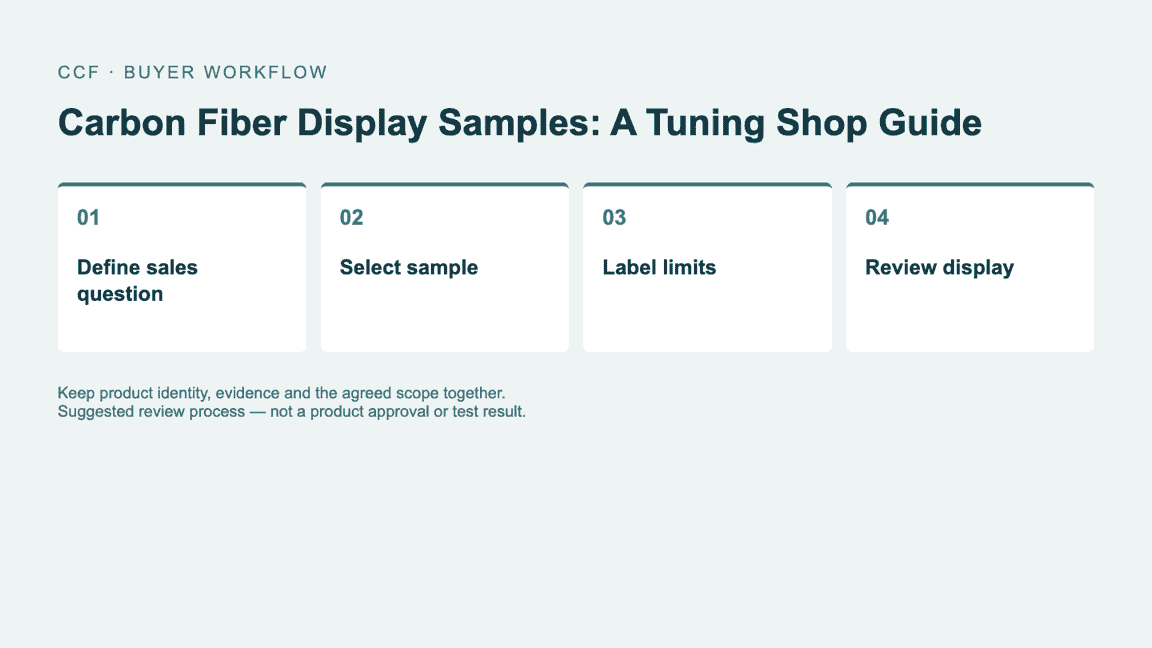
Suggested buyer workflow. Follow the product-specific specification and agreed order terms where applicable.
Give each showroom sample one sales task
Use this record as a buyer working tool. Examples and sample labels below are illustrative, not CCF inspection, order or test records.
| Record | Example or required entry |
|---|---|
| Appearance sample | Explain the visible finish; identify whether it represents a current orderable reference. |
| Interface sample | Show an actual reverse-side feature and explain what vehicle information is needed. |
| Retired sample | Label it as a non-orderable reference or remove it from the selling display. |
Keep a short sample card with the reference, purpose and last review date. Do not use a material swatch to promise the construction of every finished product.
Questions buyers ask
Should every sample be a complete body kit? No. Select enough relevant evidence to answer your customers' questions within your space and budget. Some decisions require a complete assembly; others can be explained with a clearly identified part.
Can a sample be sold later? Treat its condition, completeness and applicable terms honestly. Do not represent a handled display item as untouched stock.
For the related buying decisions, see Matching Carbon Fiber Weave and Finish Across a BMW Exterior Package and Carbon Fiber Dealer Agreements: Questions About Territory, Sales Channels and Support.
Build a display that earns its space
Send CCF your main vehicle applications and the questions your customers ask most often. Request suitable sample options and their actual product references. Invest in a display that helps your team quote accurately, not just decorate the showroom.
Send an Inquiry
Include the article title, selected parts, quantity and delivery country.