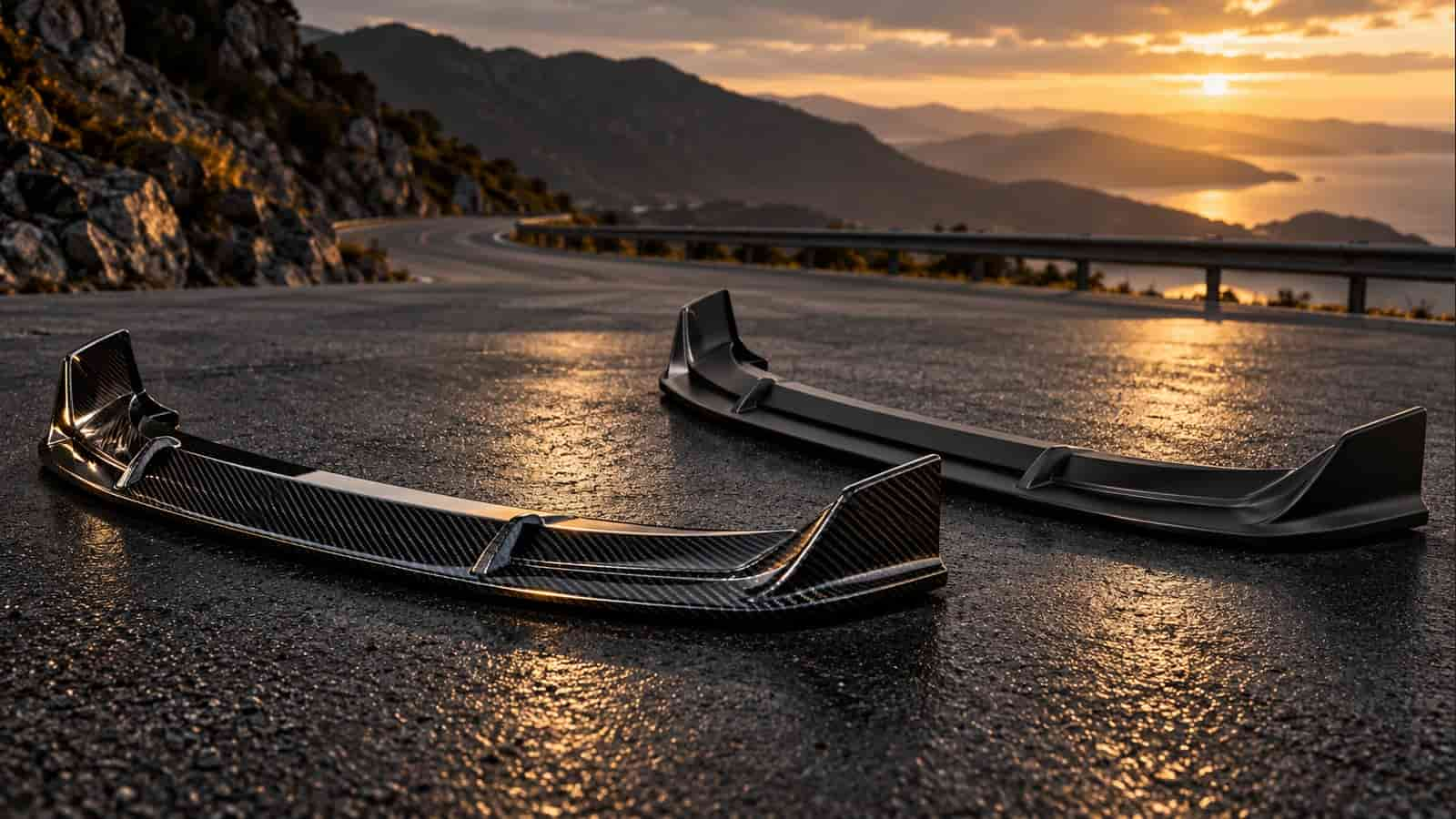
Choose between a carbon fiber and an ABS front lip using the specific product, installed clearance, appearance goal and replacement budget. Material names alone do not establish which lip will survive a driveway strike or fit a particular bumper. Compare the complete ownership and installation decision before presenting either option as better for daily use.
A daily-driven car may face different ownership decisions from a display build, but neither label tells the full story. A careful owner can still encounter a steep driveway. A more expensive part does not remove that risk. Explain the trade-offs before the customer mistakes an appearance upgrade for a promise against road damage.
First clarify what the customer means by “better”
Ask the customer to rank appearance, budget, clearance, installation scope and future replacement cost. Someone who specifically wants visible carbon weave is making a different choice from someone who wants a black lower-bumper accent at the lowest total cost. Neither preference should be dismissed.
A useful opening question is: “If this part is damaged during normal use, what replacement cost would you be comfortable with?” This is not a prediction that it will fail. It identifies whether the proposed upgrade fits the customer’s ownership budget as well as the initial invoice.
Also ask about suspension changes, frequently used parking ramps and whether the car already scrapes. The front lip clearance guide covers the measurements and configuration questions that a material comparison cannot answer.
Verify the product behind the material label
For the carbon option, ask what “carbon fiber” describes: visible surface, substrate, construction and finish. The full-carbon versus fiberglass-backed guide explains why a material name should not replace a complete specification.
For an ABS option, obtain the supplier’s actual material and finish description rather than treating every black plastic lip as ABS. Do not compare a documented product with an unidentified marketplace image and present the conclusion as a controlled material test.
For both options, confirm the vehicle application, dimensions, supplied components and installation requirements. A correctly specified material does not compensate for a part intended for a different bumper or body variant. Compare like-for-like scope before discussing price.
Explain the material difference without inventing a performance ranking
ABS is an engineering thermoplastic; SABIC’s ABS overview describes a material family, not a certification of a finished front lip. Its grade and the part design still need to be specified. A carbon-fiber composite instead combines reinforcement with a resin system, and may include other materials depending on construction.
For epoxy-based composites, cured resin should not be treated as a plastic that can simply be melted back into shape. Easy Composites’ laminating-resin guidance distinguishes thermosetting epoxy from thermoformable plastic. This does not identify the resin in every carbon lip, nor authorize heat correction. It explains why a shop should request the actual construction before proposing a repair or adjustment.
The practical implication is to ask different specification questions, not declare a universal crash winner. A resin datasheet or raw-material description is not a test of the complete installed part.
A customer-facing comparison that avoids exaggerated claims
| Buying factor | Carbon fiber option: what to establish | ABS option: what to establish |
|---|---|---|
| Appearance | Exposed weave, finish and visible coverage | Surface finish, color and any painting requirement |
| Construction | Actual product construction, not only a style name | Actual material specification, not only appearance |
| Daily clearance | Product projection and height on the actual vehicle | The same geometry and vehicle checks |
| Damage expectations | Product-specific information; no universal impact guarantee | Product-specific information; no blanket “unbreakable” claim |
| Replacement budget | Current part, freight and installation scope | Equivalent complete replacement scope |
| Repair decision | Assessment appropriate to the actual damage | Assessment appropriate to the actual damage |
Avoid a simple winner column. The table is intended to make the recommendation defensible, not to make one material win every row. CCF’s carbon fiber sourcing discussion should not imply that CCF stocks or supplies the ABS alternative.
Explain clearance before discussing durability
Ground clearance and forward projection affect whether a particular lip suits a customer’s routes and vehicle configuration. The same material can appear in products with very different geometry. Do not promise that selecting a different material will solve a clearance problem without assessing the proposed design.
Record the current setup and the proposed change. If the customer is already uncertain about frequent scraping, explain what is known and what requires the installer’s assessment. Avoid quoting a universal “safe” clearance dimension for all roads and driving conditions.
This is also a useful point to discuss the customer’s tolerance for visible wear and replacement. Some buyers accept a component as an appearance item with a potential replacement cost. Others expect a long-term fit-and-forget upgrade. Your quotation should not leave those expectations unspoken.
Compare complete ownership decisions, not just shelf prices
Include the product, delivery, required accessories and installation in the initial comparison. If discussing possible future replacement, use current known costs as an illustration rather than forecasting a lifespan. There is no defensible annual ownership figure without assumptions about damage, use and future pricing.
A simple calculation is: replacement outlay equals the replacement part plus delivery plus removal and fitting work, with any assessed restoration or additional items added separately. Use the customer’s actual quotation values. Do not insert an invented damage frequency or claim that one material always saves money over several years.
If damage occurs later, the repair-or-replacement guide can structure the next decision. A cosmetic photograph alone should not be used to certify that a damaged component remains suitable for use.
Three useful conversations for the sales desk
For a customer seeking a visible-carbon finish, start with a product that meets the vehicle application and appearance brief. Explain the supplied scope, care information and replacement budget. Do not sell it primarily through an unverified strength or weight claim.
For a customer prioritizing the lowest initial expenditure, compare complete installed quotes. If an alternative better matches the budget, say so. A well-matched recommendation can prevent a return, an unhappy customer and a wasted installation slot.
For a lowered daily driver, resolve the geometry and use questions first. A customer who repeatedly damages the existing lip may benefit from changing the design or delaying the upgrade rather than buying another material on the assumption it cannot be damaged.
The customer budget and upgrade package guide helps shops offer staged options without forcing every buyer into the most expensive combination.
Record why the customer chose the part
A short approval note can identify the vehicle, product, finish, installation scope and the buyer’s priorities. It should also state any unresolved detail before the order is accepted. This is better than a broad disclaimer that tries to shift every responsibility to the customer.
For wholesale buyers, retain the same product description in the supplier order and dealer listing. Do not let “carbon style,” “carbon look” and a verified carbon construction description become interchangeable as information passes between businesses.
Frequently asked questions
Is carbon fiber always more durable than ABS for a front lip?
That conclusion cannot be made from the names alone. Product construction, geometry, attachment and the type of loading matter. Use relevant product evidence and avoid unsupported comparative guarantees.
Will a carbon lip make a daily driver impractical?
Not necessarily. Assess the specific lip and vehicle setup, the customer’s routes and their budget for maintenance or replacement. A universal answer overlooks the actual application.
Should a shop stock only one material?
That is a merchandising decision based on customers and supplier capability. Start with the demand you can serve accurately, and avoid describing unverified alternatives as equivalent products.
Match the carbon option to a real customer brief
Send CCF the vehicle configuration, desired appearance, product reference, quantity and destination. Request the carbon product’s construction, application and supplied scope, then compare it against the customer’s priorities. Sell a clearly defined upgrade—not an unsupported promise that any material can defeat every driveway.
Send Your Product Enquiry
Include your company, vehicle details, product reference, quantity and destination.